The Temminck's Stints remain on the farms, with five birds seen together on Sunday afternoon. On Saturday a Grey-faced Buzzard was soaring overhead, the first of this species seen here this autumn.
The first Grey-faced Buzzard passing through IRRI this autumn.
Two Temminck's Stints....
...with two more about 10m away. A fifth bird was deeper into the vegetation on this field and therefore hard to photograph.
Sunday, November 3, 2013
Friday, November 1, 2013
Ringing at IRRI - 1st Nov
Our first attempt at ringing at night, which was less than 100% successful. We set up the nets in the late afternoon, and unfurled them at midnight. There was no moon at all, and in the end there were no birds either! A Snipe spp flew into one of the nets early on, but didn't get caught and escaped. Apart from that one bat (Geoffrey's Rousette) and several bugs were all we caught until the sun came up. A disappointing night, but one we shall repeat in 2 weeks when the moon is full.
Birds heard in the night included Grass Owl, Philippine Scops Owl and lots of Black-crowned Night Herons.
The first catch of the night was this, Geoffrey's Rousette, Rousettus amplexicaudatus. What an excellent name!
(Thanks to Medel Silvosa and Rai Gomez through the Philippine Biodiversity net page on Facebook for the ID)
Chinese Soft-shell Turtle, Pelodiscus sinensis. An invasive species. Found on the track during the night.
(Thanks to Emerson Sy through the Philippine Biodiversity net page on Facebook for the ID)
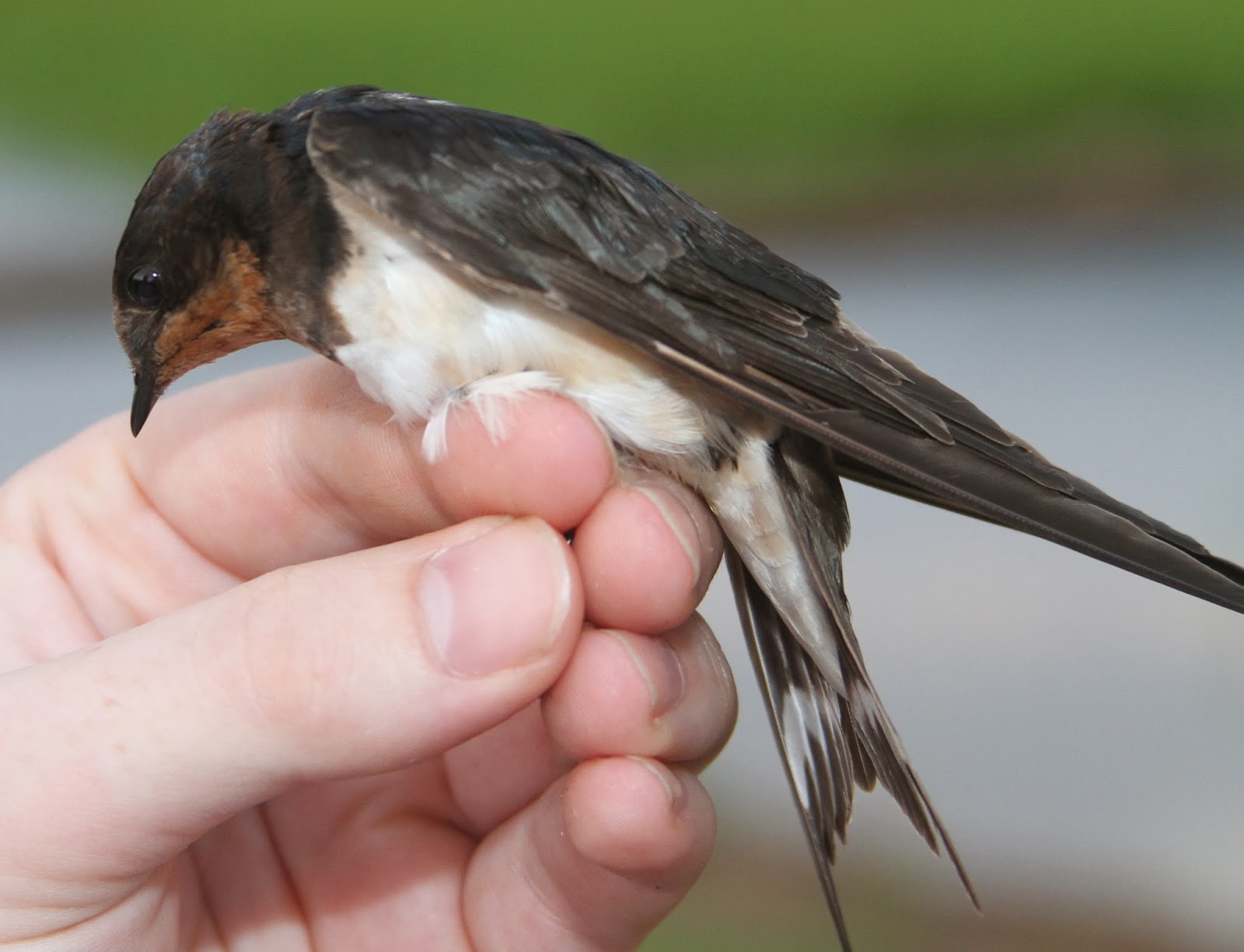
No birds at all were trapped during the night, the first didn't arrive until about 6:00am in the shape of this Barn Swallow....
...closely followed by a couple of juvenile Yellow Wagtails
Temminck's Stints at IRRI - 1 Nov
Over the last couple of days a small group of Temminck's Stints have been present in the fields at IRRI. They were first seen about midday on 31 Oct, and were still present on the afternoon of 1 Nov. The group consists of at least 3, and possibly as many as 5 birds (an unidentified flock of 5 stints was observed in the early morning of 1 Nov)
This was the first seen (bird 1), on 31 Oct, a further two birds were nearby in the same fields (birds 2 & 3). The leg colour is obscured by the sticky mud, but the brown tones to the upperparts, and the breast band are good indicators. This individual took flight while I was photographing birds 2 & 3...
Possibly the same bird seen a little later in a different field about 100m from the first site.
Note in these two pictures the long tail extending past the primaries, unlike all other stints that occur in The Philippines
These two were in exactly the same place as birds 2 & 3 on 1 Nov. The light is a little better, and the legs are a little cleaner, making the yellowish tone to the legs more visible...
...most noticeably on this individual.
This was the bird present (in exactly the same field) on 30 Sept.
Wednesday, October 30, 2013
IRRI - 31st October
Wednesday saw Richard and I ringing again, trying to get a better look at the Acros we had on Monday, but no luck there. We did have lots of other birds though, including 4 Brown Shrikes, 3 Striated Grassbirds and many Chestnut Munias. The last catch of the evening was a bat which we managed to release without being bitten. A major achievement! A flock of 4 Grey Herons overhead was interesting, my first record at IRRI of this common species.
Thursday was dry, and a quick drive around the fields produced an amazing 3 Temminck's Stints and 2 Long-toed Stints, among many other commoner birds.
Male Painted Snipe with its brood. Very cute chicks they make too!
One of at least three Temminck's Stint in the fields on Thursday.
(My initial identification was Rufous-necked, which is obviously wrong. I was thrown by the muddy legs is my only excuse!)
This group of 4 young Grey Herons flying over the farm on Wednesday is the first sighting I've had of this species at IRRI.
Ringing on Wednesday produced this juvenile White-breasted Waterhen, among others.
Monday, October 28, 2013
29th October - IRRI
Several holidays in close proximity have given me a week off work. As my better half is also away this is clearly a great excuse to go birding. On the morning dog-walk I spotted a Peregrine and a Common Kestrel sharing the same pylon. A later trip into the fields produced several Snipe spp, as well as a smattering of other obliging birds. Coupled with the large number of Oriental Reed Warblers from yesterday it looks like there's some ongoing migration happening.
Classic view of a classic bird, Common Kestrel.
While watching the Peregrine I noticed this Common Kestrel sitting just opposite. Not a common migrant at IRRI.
Adult calidus Peregrine. Has the juvenile from the past few years grown up or is this a different bird?
Common Sandpiper
Cinnamon Bittern, really living up to its name.
Snipe spp. Lots around at the moment...
Greater Musky Fruit Bat, Ptenochirus jagori, roosting under the eaves of one of the main buildings at IRRI.
(Thanks to Rai Gomez through the Philippine Biodiversity net page on Facebook for the ID)
Ringing at IRRI - 28th October
A very interesting afternoon spent ringing with Richard on the farms. The initial catch (2pm - 4pm) was exclusively Chestnut Munias, but as the light faded we started to get a few different things, including several Acrocephalus warblers, which presented more of an identification challenge than I expected. Certainly some were Oriental Reed Warblers, and some of the smaller birds could only have been the resident harterti race of Clamorous Reed Warbler, however there were a couple which I am still unsure about. I think we shall revisit the area soon, and try to get a bit more experience at identifying these tricky birds.
While ringing Richard spotted the calidus Peregrine had arrived, the first sighting this winter.
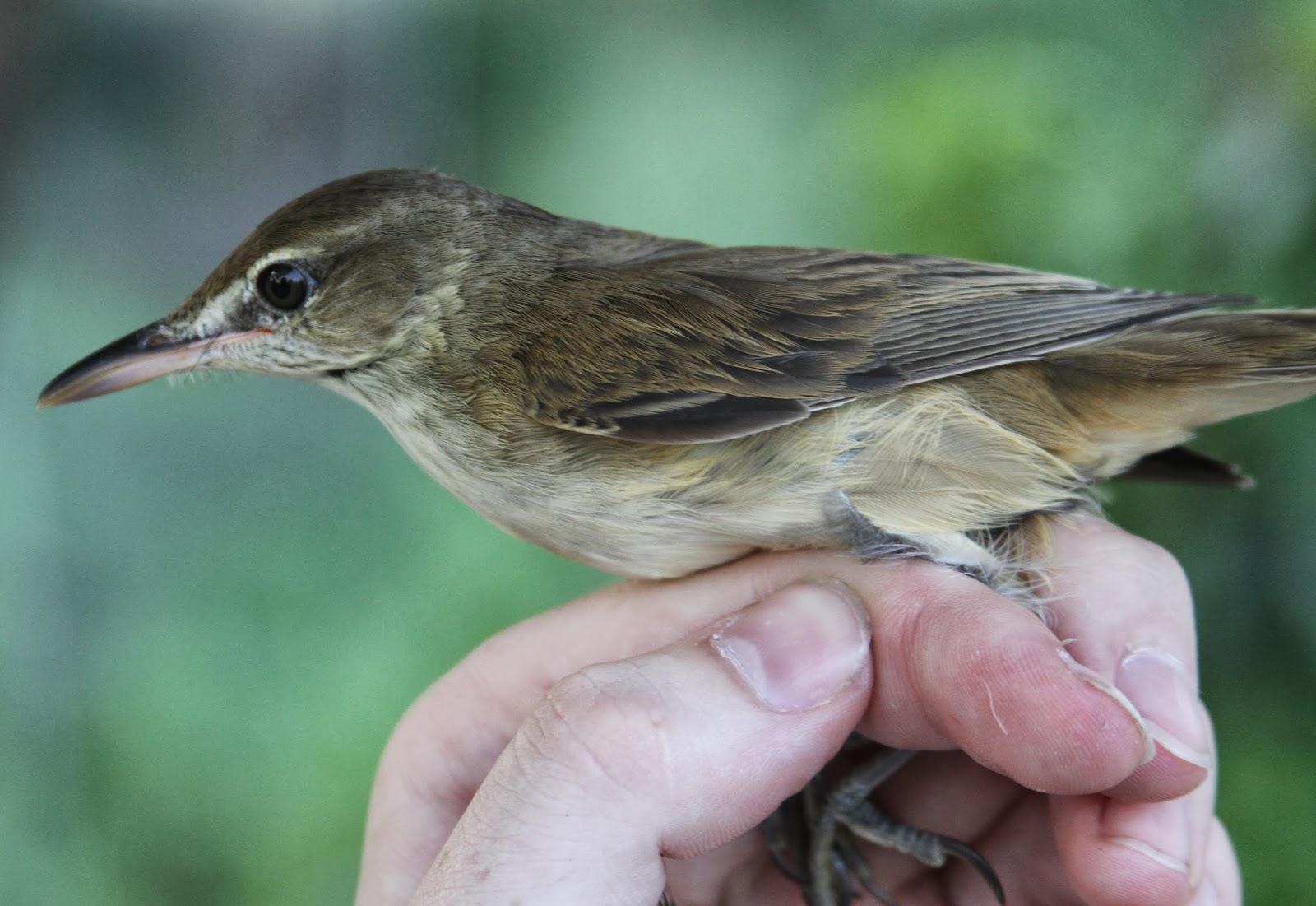
Several large Acrocephalus warblers were trapped towards the end of the day, and presented more of an identification challenge than I had anticipated. This first bird showed clear streaking on the breast...
... quite striking at certain angles, and had measurements (weight, length, wing length) that exceeded the (presumably median) values given in Kennedy for Oriental Reed Warbler. Overall the harterti race of Clamorous Reed Warbler we get on Luzon is said to be smaller than other races.
With little biometric data to refer to it is hard to make definitive identifications based on measurements alone. The plumage tones of this bird are interesting, it appears to be a 'colder' brown than the next one we caught...
The second of several Acros. One of the features said to separate Oriental from Clamorous is the latter's relatively finer bill, and less distinct supercilium. Based on that alone I see little distinction between the two birds....
...though the plumage of the second has a 'warmer' tone...
...both species show pale buffy tips to the tail feathers...
...but the second bird has clearly emarginated primaries, most notably P3 and P4. Is P5 emarginated or just slightly bent? If it was it would rule out Oriental. Phil Round points out that as orientalis moults on its breeding grounds this has to be the resident harterti anyway!
At some angles the second bird had clear throat streaking. Apparently some juvenile Clamorous Reed Warblers show some breast streaking, it doesn't seem to be the clinching feature I imagined it to be...
Less difficult to identify, we caught lots of Chestnut Munias, including this immature ...
...this one is approaching adult plumage...
... and several adults.
Sunday, October 20, 2013
Week ending 20th October - Makiling, IRRI
The rains seem to have dried up this week, apart from a few showers. The weekend in particular saw blue skies and blazing sun. I tried a hike up Mt Makiling on Tuesday (holiday due to Eid al Adha), but there was little around. A pair of Philippine Trogons were the best birds of the day.
The fields were also quiet, with a Kentish Plover, some Long-toed Stints and an few Black-winged Stilts the main birds of interest.
A hike up Mt Makiling produced this female Philippine Trogon, but little else
The Common Kingfishers have arrived!
The long bill of this dealbatus Kentish Plover is the principal difference with alexandrinus.
Plenty of Long-toed Stints still about
Long-tailed Shrike
Subscribe to:
Posts (Atom)