Thursday, June 13, 2013

Kitanglad, 7 - 10 June

When researching this leg of my birding trip I could find few references to trips up Kitanglad in June. People I spoke to warned me about heavy rain, possible flooding, even typhoons, but few people talked about the birds. In many ways the warnings were correct. The weather was on occasion extremely wet, if not actually raining then threatening to do so, with bright sunny skies very much the exception. The birds however were great! Many species were feeding offspring, and were highly active and visible. Raptors seemed to pop out every time the weather cleared up enough for them to fly, possibly driven out of cover by hunger, and species that I had found hard to see in January 2011 seemed to be making an effort to catch my eye. An exception were the owls, only one species of which (Giant Scops) was calling at all, and that was not responding to playback.

We arrived in the mid-afternoon of 7th June, after a journey involving planes, cars, motorbikes, horses and shanks' pony. The first Kitanglad birds were several Bukidnon Woodcock that gave prolonged displays around the lodge, they were to do so at about 6:00pm every night, with a shorter visit at about 4:50am every morning. Both Philippine Nightjar and Great-eared Nightjar also showed at sunset, and at every subsequent sunset as well.

Day 1: The first day's birding started brightly, but as soon as we got to the eagle viewing point the clouds dropped, and we spent a frustrating 6 hours waiting for the eagle to show. It was not a total washout of course, the dry spells produced a range of birds including Mindanao Hornbill (1), Montane Racquet-tail (12), Black-masked White-eye (5), Red-headed Tailorbird (2), Cinnamon Ibon (2), Stripe-breasted Rhabdornis (2), Short-tailed Glossy Starling, White-browed Shortwing (calling everywhere, and 1 tempted into the open), Peregrine (1 ssp. ernesti), White-cheeked Bullfinch (4) and Apo Myna (1).

We descended the mountain at about 2:00pm in pouring rain, and gave up for the day.

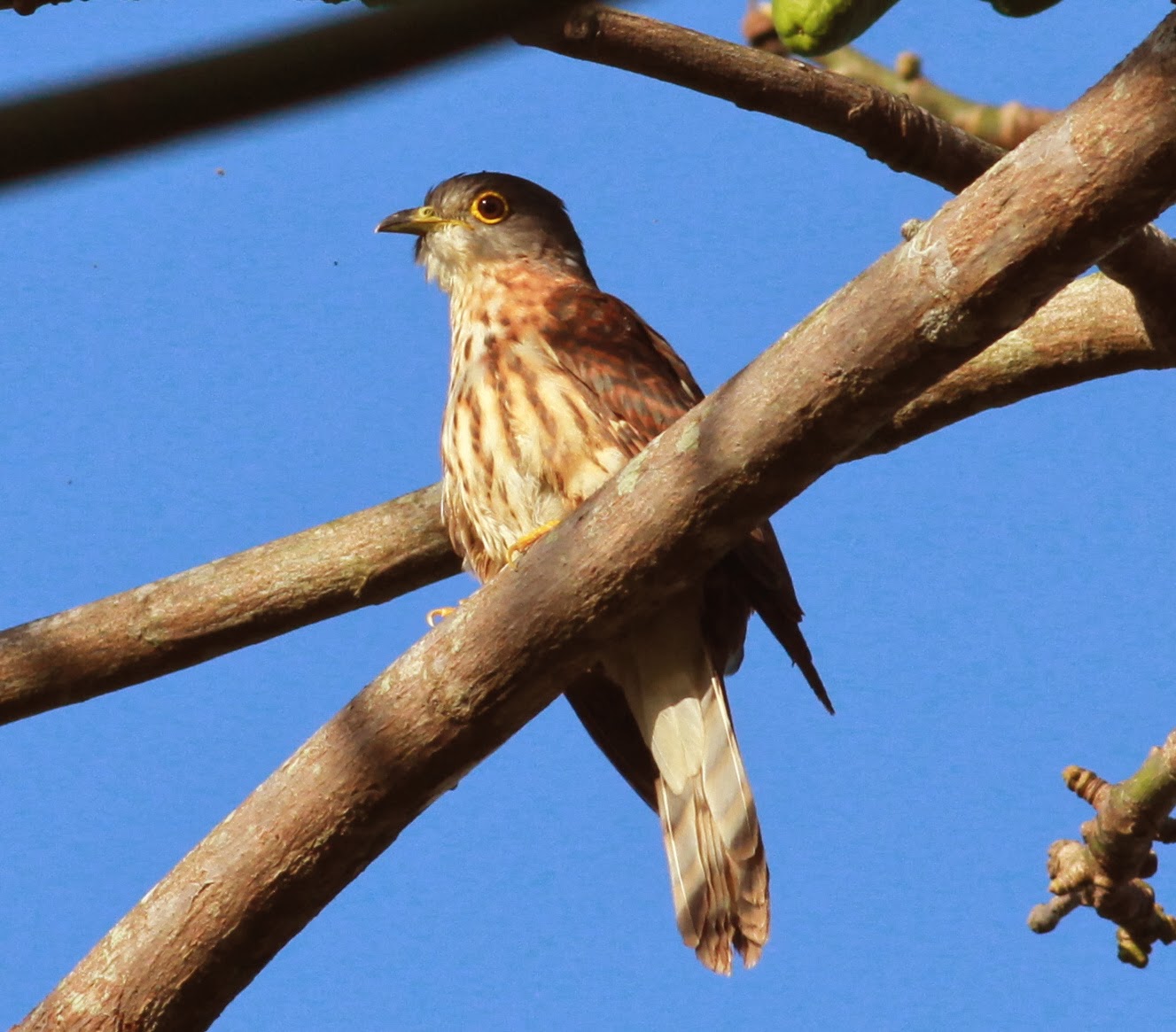
Day 2: The next morning was duller than the first, and we our expectations were low when we approached the eagle view point. We set up the scope as before, and started scanning. A mere 30 minutes into the day we had it, a Philippine Eagle perched on the mountain, about halfway up, fantastic. It soon disappeared and we spent a frantic 10 minutes trying to relocate it when Danny picked it up, much closer. It soon moved again, flying directly towards us, landing about 150m away. We watched for over an hour, getting fantastic scope views as it searched through the canopy for prey. Eventually it dropped below our sightline, and we moved up towards the higher elevations, absoultely delighted with our views. The rest of the day was excellent, with plenty more Montane Racquet-tails (20+), Cinnamon Ibon (50+), White-cheeked Bullfinch (5), Black-masked White-eye (4), Apo Myna (8), White-browed Shortwing (1) and Stripe-breasted Rhabdornis (8). We also found several species new for the trip, including Oriental Honey Buzzard (1), Besra (1), Buff-spotted Flameback (1), MacGregor's Cusckooshrike (10+), Apo Sunbird (1) and Red-eared Parrtofinch (1).

On the way down we found two raptors near the camp. The first was a Pinsker's Hawk-Eagle, the second a Black-shouldered Kite, my first for The Philippines, and a totally unexpected bird.

Day 3: Our third and last day was spent on an easy wander to areas near the lodge, looking for whatever we might find. The slower pace was rewarding, and we found and photographed Red-headed Tailorbird and Snowy-browed Flycatcher. While looking at this last Carlito jumped up and called out 'Eagle'. The Philippine Eagle was perched on a branch about 100m away! While we watched it took off and flew directly towards us, landing on a tree about 40m away. We wrestled briefly with the vegetation, but soon got fantastic views. I don't really have words for how we felt, any birder reading this will know....

In summary, birding Kitanglad in June is a real test of any birder's waterproofing arrangements. Our waterproof jackets weren't, and our feet and clothes were permanently sodden. In addition the leeches were rapacious (I won the leech count with 45). On the other hand, the birds were great. All the endemics are there, and most are breeding. Many species seem to be easier to see than at other times of year, though definitely not all, missing the owls was a big disappointment. If you're well prepared, can protect your camera, and have stocked up on leech socks (and I really mean that!) then you've got a great chance to see some great birds.

Philippine Eagle. Awesome is a much overused word that has lost most of its currency, a pity as awe is what I felt when I saw this bird...


Red-headed Tailorbird.
Stripe-breasted Rhabdornis.
Apo Myna.
White-cheeked Bullfinch, ssp steerei. Seen daily, mostly at about the same altitude as the eagle viewpoint..
MacGregor's Cuckooshrike. Quite numerous in the mixed flocks above the eagle view point.
Juvenile Little Pied Flycatcher
Juvenile White-browed Shortwing, ssp. mindanensis.Calling everywhere, this was the second bird we saw in 2 days.

Grey-hooded Sunbird, feeding on a banana flower
Male Snowy-browed Flycatcher, ssp. montigena. Note the dark reddish brown tail, the identifying feature of this race.
Black-shouldered Kite. A surprisingly thinly distributed bird in The Philippines. I was expecting this in rice fields, not up a mountain...
Mock Viper, Psammodynastes pulverulentus. On the trail high up on Kitanglad.

Carlito (2nd from right), Danny (3rd from left and Amelia (1st on the right) with the rest of their family. Great birders, great people...


Wednesday, June 12, 2013

Pelagic out of Siargao, 3-4 June

My interest in a pelagic trip to this region was sparked by an article in Birding Asia 16 (December 2011). The proximity of such deep waters as the Philippine Trench to the coast of The Philippines was news to me, and I was immediately intrigued. I contacted a fishing operator on Siargao, and advertised for anyone fool enough to want to come with me. I soon filled the available spots, and having settled on a date of 3rd June we all met up at the appointed time.

We had had many discussions about the correct method of making and using chum, and we had little information about where to go looking for the birds. Our captain, Steve Brown, was very knowledgeable about fishing, but while he had a keen interest in the birds, he didn't have much specific knowledge. Nevertheless we set off to sea, with a heady mix of anticipation and trepidation. The birds themselves took a while to appear, but once we had reached a decent distance offshore they started to show themselves. The first bird we saw was a Brown Booby, powering past us, but soon after that we started to see what we were really looking for, tubenoses. The majority at first were dark phase Wedge-tailed Shearwaters, with a few Streaked Shearwaters added in. Eventually Rob shouted out that he had something more interesting, Bulwer's Petrel. There are few accepted records of this species in The Philippines, we were to record 5 over the 2 days.

(The chum we had made (Vegetable oil, chopped up fresh fish, bait additive) seemed partially effective, with at least some of each of the three species of tubenose appearing to come closer to our boat, though none alighted on the slick. An excellent resource for this was the Scillypelagics website.)

After waiting for quite a while, and adding Lesser Frigatebird to our list, we headed inshore to an island that Steve knew where he thought there were breeding terns. As we approached the island (Rock Island, opposite the viewing tower at cloud 9 beach) we started to see quite a number of terns, while most were the common Black-naped Tern, there were at least 5 Bridled Terns amongst them, as well as several birds with bright red feet and bills, Roseate Terns! We eventually recorded 14 of these beautiful birds, and it seems entirely possible that they are using this tiny islet to breed, potentially the first breeding record of this species in The Philippines.

We eventually saw 8 Wedge-tailed Shearwaters, 9 Streaked Shearwaters, 3 Bulwer's Petrels, 3 Brown Boobys, 1 Lesser Frigatebird, 76 Black-naped Tern, 14 Roseate Tern and 5 Bridled Tern.

Bulwer's Petrel, showing the characteristic flight profile...
...and upperwing pattern.
Dark phase Wedge-tailed Shearwater
Streaked Shearwater
Brown Booby
Roseate Terns
Bridled Tern

One of a pod of about 15 or so Common Bottle-nosed Dolphins we found as we came back towards land.


After such a good day 5 of the 7 of us tried again on the 4th June. We had slightly different conditions (lots of rain showers to dodge), and fewer birds. The only things we saw that were different were 2 Little Terns and about 15 Common Terns on the way out, and a single pale phase Wedge-tailed Shearwater. Aside from that the same set of birds were seen, several dark phase Wedge-tailed Shearwaters, some Streaked Sherwater, 2 Bulwer's Petrel. On the way back we stopped in at some mangroves close to General Luna which were beautiful, though relatively birdless. On the way out we found a small flock of Pied Imperial Pigeons on one of the tiny offshore islands covered in forest.

Pied Imperial Pigeon, quite a few on the small islands offshore from Gen. Luna.


Mahayahay, Siargao - 2nd June

My first visit to Siargao, a small island off the northeastern tip of Mindanao. It's renowned as having the best surfing conditions in The Philippines, and is the closest point to the Philippine Trench. This is a deep channel stretching up the south-east Asian archipelago from New Guinea up the eastern side of Indonesia to The Philippines. It is one of the deepest submarine trenches in the world, reaching a maximum recorded depth of 10,540m (The Marianas Trench is a mere 323m deeper). With such deep water lying not far offshore the potential for interesting pelagic birds (and mammals) is high, so I and a small group of intrepid birding friends decided to go and have a look.

Few birders have visited the island, and fewer still have published trip reports, so we spent the first afternoon exploring a small patch of forest close to a village called Mahayahay. We parked in the village, engaged a guide after first contacting the Barangay captain, and set off on foot to the forest. The habitat was generally very degraded, but there seemed to be plenty of birdlife. The route we took led us in a circle through degraded forest, secondary growth, coconut plantations and a small patch of grassland. We encountered a couple of streams, one of which flowed out of a cave which our guide said contained bats. Among the more interesting birds seen were Oriental Honey Buzzard, Barred Honey Buzzard, Philippine Serpent Eagle, Philippine Green Pigeon,  Black-headed Tailorbird, Rufous-fronted Tailorbird and Handsome Sunbird. Heard only birds (by me) included Ruddy Kingfisher, Philippine Oriole, Hooded Pitta, Koel, Black-faced Coucal and Black-chinned Fruit Dove. though some of these were seen by other members of the group.

That evening we tried looking for owls at a likely spot along the road, near Napa. We had no luck at all with any owls, but did find an interesting Fruit Bat.

Black-naped Oriole, common in this very degraded habitat.
One of three Black-headed Tailorbirds that kept us entertained for a long while. They were typically very flighty, but responded very well to playback, and stayed around us for at least half an hour.

Barred Honey Buzzard flying low overhead on the way out of the forest.

Flying Lizard spp.
Fruit Bat spp.

Saturday, May 18, 2013

Week ending 19th May - IRRI & Makiling

It's been very hot recently, with a few early rain storm, consequently birding is slow and there isn't much to report. I've been pottering around the fields a few times, and spent a very quiet morning hiking up Makiling with Richard. The only birds we saw was a single male Spotted Wood-Kingfisher and a Balicassiao on a nest. Other things were calling, and some Philippine Macaques provided some brief diversion, but it was a very quiet day indeed.

A strange sight this weekend was this young Philippine Magpie Robin. I've seen them quite a lot on Mindoro, Siquijor, Subic etc, but never before in the Makiling area, and certainly never before in my garden!


Still lots of Blue-tailed Bee-eaters at the farms.

Male Red Turtle Dove
Balicassiao on a nest...
Lots of both House Swift and Striated Swallow nesting beneath Palma bridge on the UPLB campus. I can't see a substantial difference between the nests, and assume the nests are all built by the Swallows, with the House Swifts using older ones from previous years.


Wednesday, April 24, 2013

IRRI - 24th April.

A very pleasant hour or so spent in the fields this afternoon. Lots of birds around, including flocks of Oriental Pratincoles and Blue-tailed Bee-eaters who've moved in for the summer, and Brown Shrikes and a few Yellow Wagtails who haven't left yet.

Few waders apart from the odd Little Ringed Plover and Common Sandpiper, but plenty of other things to hold the interest.

 Plenty of Oriental Pratincoles about...
...but a bit hard to photograph in flight.
Blue-tailed Bee-eaters have also arrived in force..
The White-collared Kingfishers never left...
 ..and nor did the Pacific Swallows...
...or the Barred Rails.

The Brown Shrikes are getting ready to travel north...

... as are the Yellow Wagtails.


Saturday, April 20, 2013

UPLB - 20 - 21 April

Due to the excessive heat I've done most of my birding this weekend at night. The first bird heard on both nights, from my house, has been a Philippine Eagle-Owl. It appears to be in the gully running between the IRRI staff housing complex at the SEARCA housing area. This thin tongue of forest has produced Red-bellied Pitta before, with Indigo-banded Kingfisher on the stream at the bottom of the gully, but I wasn't expecting an Eagle-Owl!

A good area for owls seems to be Baker Field in the middle of the campus. There are plenty of trees, but they are generally not too tall, and are easy to walk around. On Sunday morning I had a pair of Philippine Scops Owls here, responding quickly to playback here, and there were several Luzon Hawk-Owls calling. I got views of the Luzon Hawk-Owls on the road up the hill towards the Botanical Gardens, but they didn't hang around for pictures.

Philippine Nightjars were also very actively calling, though I didn't manage to see any.

One of a pair of very responsive Philippine Scops Owls at Baker Field. This one seems to have caught a large rat.

Tuesday, April 9, 2013

Ponderosa Golf Club, Puerto Galera - 8th April

After San Cristobal Richard and I joined Simon on his return to Puerto Galera, and we tried for night-birds at Ponderosa the next morning. No nightjars were in evidence, but we did get a response from a recording of Mindoro Boobok, though we didn't see it at all.

We started down the quarry track at first light, but saw very little apart from Mindoro Bulbuls and Philippine Cuckoo-Doves until we got to the quarry itself. Almost immediately we had a Pink-bellied Imperial Pigeon fly past, and quickly heard Blue-crowned Racquet-tails calling, though they were never visible. A large flock of Purple Needletails hunted overhead for most of our time there, as did smaller numbers of Glossy Swifllet. Once the day had warmed up the raptors started, with first a Changeable Hawk-Eagle and then a Philippine Serpent Eagle.

On the way back we had a little more luck, with White-eared Brown Dove and Chinese Goshawk showing well, but it was basically a quiet day with a few small highlights.

An interestingly plumaged Changeable Hawk-Eagle.


White-eared Brown-Dove
Chinese Goshawk
One of many thousands of Cicadas that provided the background din to the weekend. At one point Simon measure the noise levels at 90dB.