Friday, October 11, 2013

Saturday 12th Oct - IRRI

Typhoon Santi passed through the northern part of Luzon this weekend, threatening lots of rain but not actually delivering much. On Saturday Richard and I continued the search for migrants, with little success. A pair of Plain Bush-hens were the main hightlight.

Later that afternoon I returned and located a Red-necked Phalarope and a Kentish Plover. The phalarope looks overall paler than the first about 2 weeks ago, and I'm fairly sure it's a new bird.

The Red-necked Phalarope was still present on Sunday, and the Kentish Plover count had increased to 3. On the upland farms I relocated 2 of the Little Grebes that were on the experimental station last month (1 adult and 1 juvenile)

A pair of Plain Bush Hens on the Experimental Farm. Not a common sight at IRRI, being much more often seen on the forest edge.
What I believe to be a second Red-necked Phalarope of the autumn..


 .. it appears to be somewhat paler overall than this bird that was in exactly the same field on 29th Sept, less than 2 weeks ago.


Paddyfield Pipit. I'm sure a Richard's is going to turn up soon...
Another Kentish Plover also showed up in the afternoon. This one looks comparatively small-billed, possibly alexandrinus.
 ...by Sunday afternoon there were at least 3, (and this one has a much more robust bill, surely dealbatus).
Cinnamon Bittern


Black-winged Stilt


Typhoon Santi on Friday afternoon. Lots of rain promised, but Saturday wasn't too bad at all. A bit damp to start, but it soon stopped raining, and while the sun didn't show it stayed dry most of the day.

Thursday, October 10, 2013

IRRI produces a Harrier at last! - 10th Oct

A late afternoon sprint around the farms produced some excellent birds. First up was a fantastic female Harrier spp. on the upland farms. To say that it's long overdue is to flirt wildly with understatement. The habitat at IRRI seems custom built for harriers, but they just aren't here. The fact that they are a regular feature of rice fields in other parts of the Philippines only deepens the mystery. The bird quartered the dry fields, landing a couple of times, but was heavily mobbed. I hope it stays.

While watching the harrier another new arrival in the form of a Purple Heron also took off out of the fields.

On the experimental station there are many new waders, particularly a lot of Long-toed Stints, and in amongst them a solitary juvenile Pectoral Sandpiper. The great run of waders continues!

What looks like a female Pied Harrier. My initial identification was Eastern Marsh, but the structure appears a little too lightweight for that. The head and particularly the bill seem a little small. This would be my first record of this species in The Philippines, and my first harrier of any kind at IRRI. It was severely mobbed by dozens of passerines. Lets hope it hangs around.

Any comments or corrections to this ID would be welcome!
The tail is interesting. Broad bands and a somewhat square tip suggest Pied.
The quantity of white on the rump is interesting, much more than would be expected on Eastern Marsh.
I took this to be a Sharp-tailed Sandpiper, however closer examination shows that it is in fact a juvenile Pectoral Sandpiper, a first record of this species from The Philippines! Thanks to Tom for pointing this out to me. A detailed analysis is here.


While taking photos of the Harrier this Purple Heron popped up out of the field in front of me.
Barred Rail. Not a migrant, but very obliging.


Sunday, October 6, 2013

Week ending 6th October - IRRI

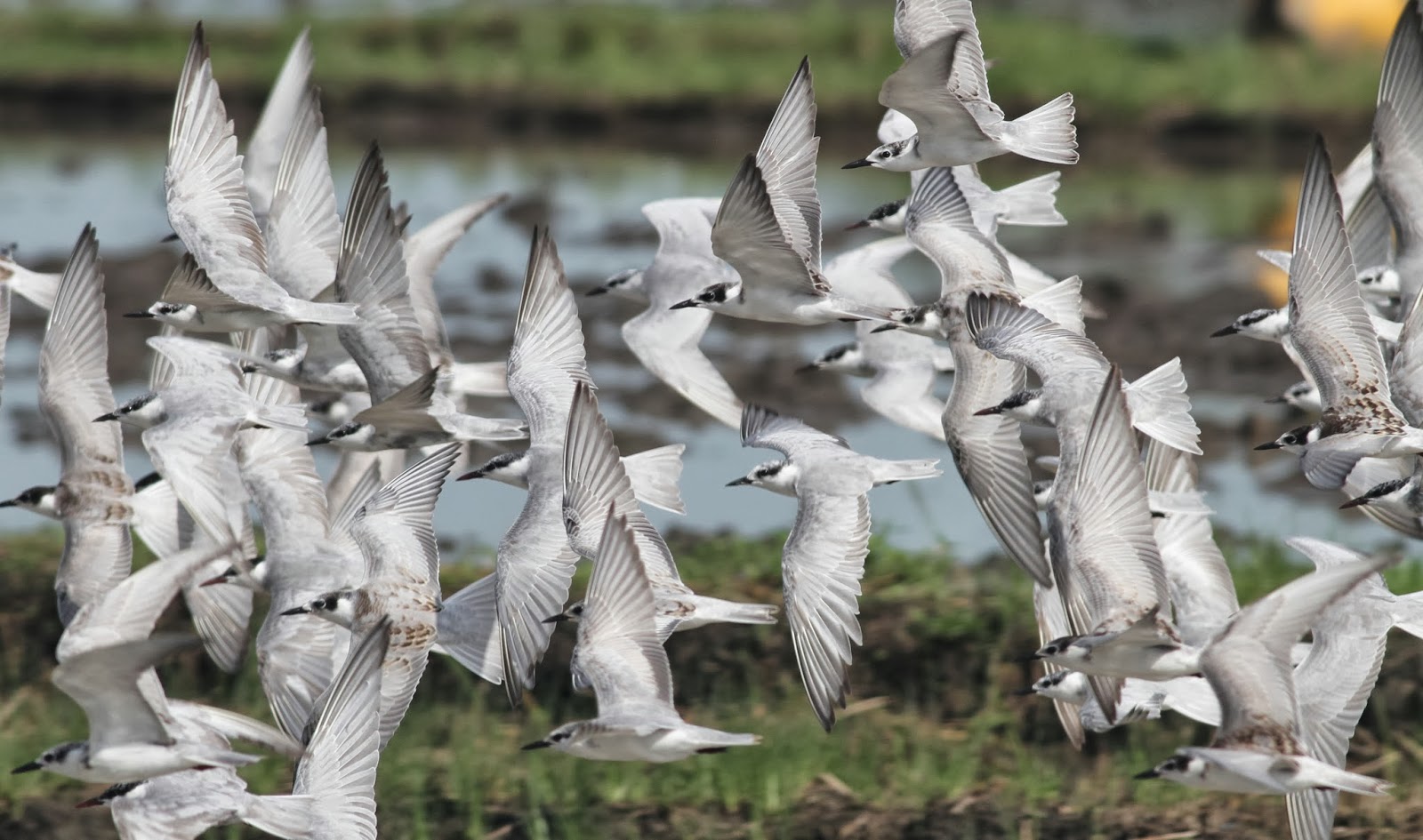
Most of last week's exciting crop of waders have moved on, leaving behind hundreds of newly arrived Whiskered Terns, and many Long-toed Stints and Wood Sandpipers. A few Black-winged Stilts are still about. Oriental Pratincoles are also gathering in a large flock, and will presumably be heading south in the next few weeks.

Whiskered Tern. Hundreds now on the farm
House Swift
Long-toed Stint. One of many passing through IRRI this week
Oriental Pratincole. A flock of several hundred is gathering on the experimental station, presumably preparatory to flying south soon.
Either Pintail Snipe or Swinhoe's Snipe....

.... Lots have arrived over the last couple of weeks.

Monday, September 30, 2013

Still more waders at IRRI - 30th Sept

The amazing run of waders at IRRI continued today with the appearance of a Temminck's Stint (last seen at IRRI on 3rd Oct 2009), and a Ruff, which is the first IRRI record as far as I know.

No sign of either the Red-necked Phalarope or the Common Redshank from the weekend, but the area of suitable habitat is large so it's possible they're hiding somewhere.

Winter plumaged Temminck's Stint. Quite a rarity here, though certainly dramatically under-reported.
Ruff. Also classified as rare, though I have seen them at Candaba and San Juan.

Friday, September 27, 2013

IRRI is a wader wonderland - 28th Sept

Typhoon Odette left us on early Wednesday morning, promptly followed by the Oriental Plovers which were last seen by me on Tuesday afternoon. Most of the other birds in their field had also left, namely all the Snipe spp. and Oriental Pratincoles. A few Pacific Golden Plovers were all that remained.

The change in weather brought in a new crop of passage birds though, with a Common Greenshank on Friday evening, and on Saturday morning the Common Redshank had been joined by a Red-necked Phalarope and a Kentish Plover. There were also a scattering of Long-toed Stints and Black-winged Stilts as well as hundreds of newly arrived Whiskered Terns.

A second look in the afternoon revealed the long-staying Marsh Sandpiper, as well as a Rufous-necked Stint and lots more Long-toed Stints.

On Sunday most of the above were still present.

Juvenile Red-necked Phalarope. My second of this species at IRRI (the first was on Oct 25th 2011), still a very unusual bird inland in The Philippines.
... the Red-necked Phalarope was still present on Sunday morning.

The Common Redshank is still present, but very flighty.


Kentish Plover. Very scarce at IRRI, and usually in mid-winter.
Common Greenshank in very bad light on Friday evening
Rufous-necked Stint. Another rare, but annual, passage migrant at IRRI that is much commoner at the coast.
Long-toed Stint. Quite a few scattered around today where there were none on Friday.
One of about a dozen Black-winged Stilts present this weekend


Whiskered Terns
 A pair of Red Turtle Doves.

A very cool looking skink in my driveway after a great morning's birding.

Tuesday, September 24, 2013

Common Redshank at IRRI - 24 Sept

An extremely wet week due to super typhoon Odette which has been keeping us well watered for several days. The Oriental Plovers were still present until Tuesday evening, in the same fields as the end of last week. Many other migrants have landed, including hundreds of Whiskered Terns and Wood Sandpipers. Several Grey Wagtails also arrived, as did a lone Common Redshank, the surprise bird of the week. I've seen them inland here at Candaba, but never before at IRRI.

The ernesti race Peregrine showed again on Monday, in heavy rain. It seems it's hanging about. We'll see what happens when the larger calidus turns up, probably next month.

My first ever Common Redshank at IRRI, long overdue!
While photographing this juvenile Oriental Pratincole the whole flock took off, several hundred birds appearing out of the ploughed field where I had only suspected a dozen or so...
... the culprit was this Peregrine, ssp. ernesti, which I have seen a couple of times over the last few weeks.
It eventually perched high on one of the pylons. Even in its bedraggled state it is clearly a very dark bird, and with a full black hood.
Odette. Pretty name, big ugly storm. Looks like another one just behind it too. No wonder lots of migrant waders take an easterly route over the Pacific.


Saturday, September 21, 2013

Week ending 21st Sept - IRRI

Migration continues with the arrival of Pacific Golden Plovers and Whiskered Terns at IRRI. The Oriental Plovers stayed throughout the week, moving around a little in the fields of the upland farm, though only 7 were seen on Monday, and no more than 6 thereafter.

Intermediate Egrets have also arrived probably in response to all the tilling activity going on in the fields. Oriental Pratincoles are staring to gather in large flocks, possibly preparing for the trip south. Large numbers of Yellow Wagtails are everywhere, with a few Grey Wagtails mixed in. There are still a few Blue-tailed Bee-eaters around as well.

Pacific Golden Plover

Adult winter plumaged Oriental Plover.

Adult Stilt, showing characteristics of White-headed Stilt.
 Whiskered Tern
Intermediate Egret
Oriental Pratincole