Friday, October 21, 2011

Swifts, Swiftlets and Needletails

A short gallery showing a few of the commoner species of Swift that hang about Makiling.

The commonest Swiftlet in the area, the ubiquitous Glossy Swiftlet. The underparts can be almost white, and the white patch on the rump varies in size quite considerably. Only really confusable with Pygmy Swiftlet, which has a truly white rump (not the silvery grey shown here)


Asian Palm Swift. A bird with a rapidly changing flight profile

Purple Needletail. Enormous, and unmistakable. Much larger than all other Swifts in Luzon.

House Swift. Regularly seen over Baker Field in UPLB, but not so common elsewhere in the IRRI/ Makiling area.
 The broad white rump is very clear in this species...

Monday, October 17, 2011

Week ending 16th October - IRRI

More migrants in evidence this week, especially on the farms. New arrivals included a Common Kingfisher, Common Kestrel and Peregrine on Saturday. The latter quite possibly the same bird that was present most of last winter, though if it is it has arrived much earlier than last year (mid November).  Several Long-toed Stints still around, along with lots of Little Ringed Plovers. Also plenty of Yellow and Grey Wagtails.

Plenty of young Rallids around as well this week, with juvenile Buff-banded and Slaty-breasted Rails to go with the White-breasted Waterhen and Moorhens that have been visible for a while.

Juvenile Buff-banded Rail
Buff-banded Rail
Juvenile Slaty-breasted Rail
Peregrine, back on the same pylon as last winter,
but quite a bit earlier.

Painted Snipe hiding in a paddy

Long-tailed Shrike
Whiskered Tern


Sunday, October 9, 2011

Week ending 9th October - IRRI


The Philippines was still dealing with the after-effects of two typhoons in a week, so it was a blustery and wet week. I did manage a couple of hours on the farms however, and the passage of Black-winged Stilts continues, with several small groups scattered about the paddies. Long-toed Stints are also moving through, with two small groups of 10+ birds present on Tuesday. Slaty-breasted Rail are now visible on practically every visit too.

The main excitement of the week was the fruiting of a large tree adjacent to the main gate at IRRI staff housing at the weekend. Lots of Lowland and Yellowish White-eyes, Yellow-vented Bulbuls, and flocks of Flower-peckers were augmented by large groups of newly arrived Chestnut-cheeked Starlings. A small flock of Philippine Green Pigeons were also present on Sunday.


Lowland White-eye.


Grey-streaked Flycatcher 


Juvenile Chestnut-cheeked Starling 


Chestnut-cheeked Starling 

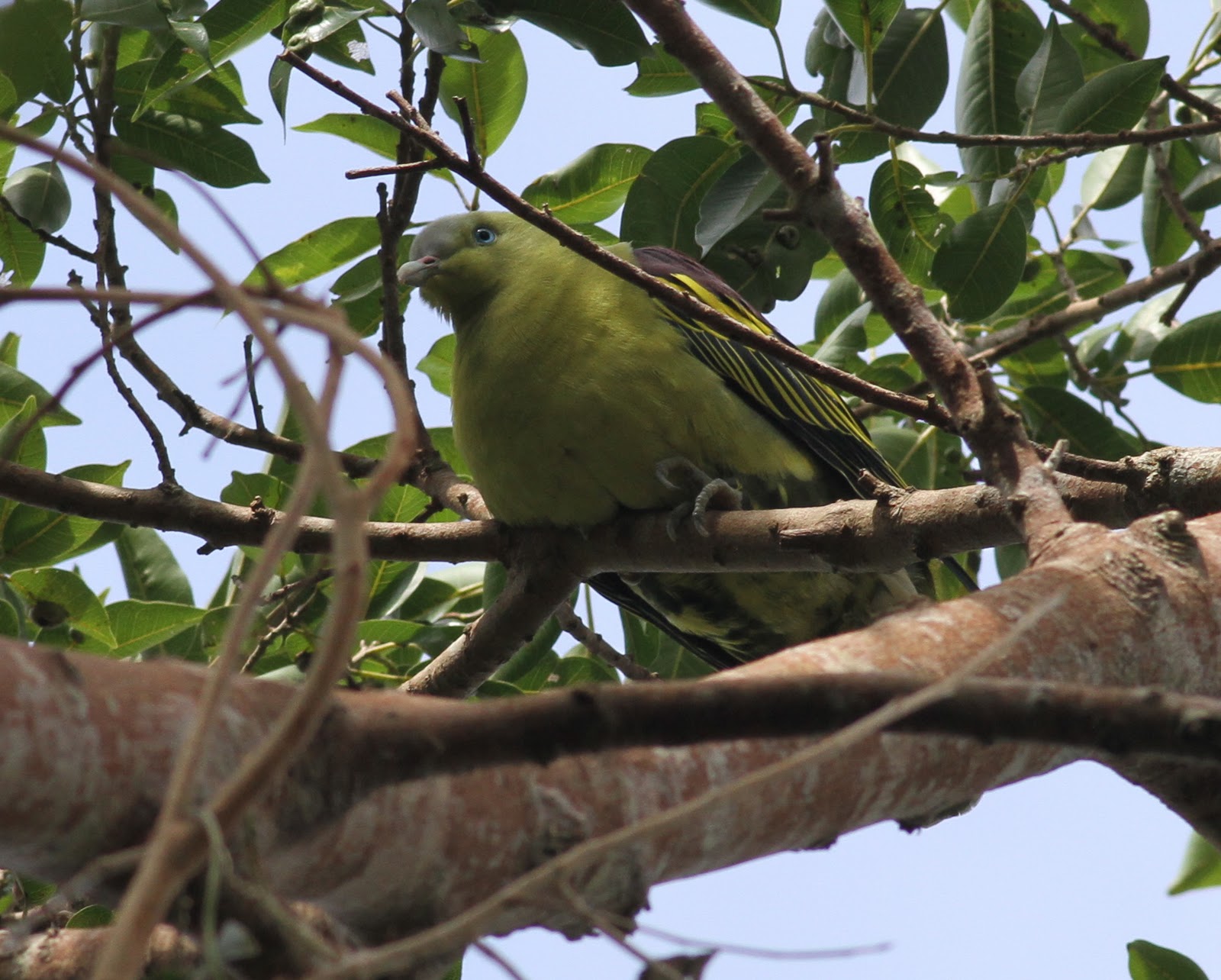
Philippine Green Pigeons Treron axillaris, recently split from Pompadour Green Pigeon Treron pompadora. According to Collar (2011) this differs from the races of T. pompadora in Vietnam, T. p. phayeri and India, T. p. affinis "on account of their red cere" (see second photo) "white (not creamy-brown) undertail coverts" (photo 3) "bluish grey (not pinkish red) legs and feet" and "lack the orange breast patch" (all pictures). In addition differs from  phayeri in "maroon (not chestnut) back" and from affinis in "much less distinctive yellow throat". To me the eye seems distinctly pale blue, compared to the darker blue of T. pompadora.

Sunday, October 2, 2011

Week ending 2nd October - IRRI, Makiling

Typhoon Pedring disturbed our tranquility on Monday and Tuesday with high winds, but not much rain. Not much to report from the farms. Whiskered Terns are now on every pond, and a large flock of Oriental Pratincoles has congregated on the upland farms. There are still plenty of Wood Sandpipers about, as well as Little Ringed Plovers, but the passage waders have moved on (barring a lonely Black-winged Stilt).

On Sunday I drove up the mountain as far as I could, to Agila Camp, at first light. The path to the top has been cleared recently, and it looks great for ground birds. I did get good views of a White-browed Shama, as well as disturbing two other birds that were just a blur of feathers. There was a fair dawn chorus, with calling birds including lots of Grey-backed Tailorbirds, some Luzon Hornbills, White-browed Shamas and others. A fruiting tree attracted Red-keeled Flowerpeckers and Buzzing Flowerpeckers, and a surprise was a pair of White-bellied Munia in some bamboo, I normally see them in the rice fields. The first Grey-streaked Flycatcher of autumn was hawking insects from a dead tree. A lone Guiabero was the only Parrot sp. On the way down a Red-bellied Pitta flushed off the road, but didn't hang about sadly.

At the base of the mountain the fig tree outside TREES lodge is in fruit, and I enjoyed good views of Red-keeled and Striped Flowerpeckers, Stripe-headed Rhabdornis, Guiabero, Coppersmith, Philippine Bulbul, Lowland White-eye and Yellowish White-eye.


Lesser Coucal


Stripe-headed Rhabdornis


Striped Flowerpecker


Coppersmith


Yellow-vented Bulbul


Monitor sp.


Gecko sp.

Two images showing the path and extent of typhoon Pedring.

Sunday, September 25, 2011

Week ending 25th September - IRRI

On Tuesday a small flock of Black-winged Stilts were on the main farm, and a juvenile Slaty-breasted Rail showed itself briefly there also. On Saturday a further two (adult) Slaty-breasted Rails were present in the same area. Maybe they've bred? Elsewhere, the Stilts were still about on Saturday, but at least three birds had badly damaged legs, evidence of some kind of trapping.

New arrivals this week included a small flock of Whiskered Terns on the upland farm, with two birds present on the lowland farm.

On Sunday I had my first twitch in the Philippines. Up to la Mesa Eco Park in Quezon City for an Ashy Ground Thrush that had been showing well. I got very brief, but conclusive views before it disappeared into the undergrowth. I think I'll try for my local ones next week!


Female Cinnamon Bittern 


Buff-banded Rail 


Black-winged Stilt 


Yellow Wagtail


Beautiful male Cinnamon Bittern. I just can't get enough of these!


One of three Black-winged Stilts sporting broken lags on Saturday morning. People living near the farms often hunt for birds using catapults and firearms (.22 rifles mostly). I haven't seen any traps there, but it looks like there must be some...


Whiskered Tern


Whiskered Tern with some remnants of breeding plumage


Slaty-breasted Rail. One of two birds seen on Saturday, with a different (juvenile) bird present on Tuesday


White-browed Crake


Juvenile White-breasted Waterhen

Monday, September 19, 2011

15th - 17th September - Siburan Prison, Mindoro

A hastily organised trip to Siburan Prison in western Mindoro to try and find some Mindoro endemics. We were lucky with the weather, which held off while we were there. but not with much else. The drive to the prison from San Jose airport is long (3 hours+), and bumpy (half is unpaved and very rough in places).

The first stop is a small lake, where we had Wandering Whistling Duck, which is thinly distributed in The Philippines. Perched in a large tree overlooking the lake was a White-breasted Sea-Eagle, and Philippine Honey Buzzard and Philippine Serpent-Eagle both showed overhead. Not much else here so we headed for the guest-house. We were assigned a guide, Jess, who knew the forest but not much about birds. An afternoon stroll up the mountain behind soon turned into a muddy scramble, for which my companions were ill-equipped in the shoe department unfortunately. Very few birds were visible or audible, with our only sightings being Balicassiao, and a stream of Palawan Crows (Split from Slender-billed, there must surely be a better name for this bird which is shared across Palawan and Mindoro) in the early evening. A Great-eared Nightjar flew across the prison assembly ground in the evening.

The next day we started early, and soon heard Black-hooded Coucal, one of our target birds, but despite repeated attempts at playback they stubbornly refused to show themselves. Mindoro Hornbills were more obliging, and we saw several groups throughout the morning. Philippine Fairy Bluebirds were quite numerous (oddly not shown as occurring in Mindoro in Kennedy et al, something that Tim had mentioned to me in the past), as were groups of Colasisi overhead. A group of Green Imperial Pigeons got our hopes up for something more interesting, but no luck there.

We got back to the guest-house sweaty, muddy and leech-ridden, with few birds to show for our efforts. No sign of Scarlet-collared Flowerpecker, and of course not a sniff of Mindoro Bleeding Heart. We were lacking a recording of Mindoro Hawk Owl so that was off the list from the start.

The trip back to San Jose was uneventful, barring a small group of Coleto flying over the road.

All in all a disappointing trip, but one that showed the relatively simple logistics involved in getting to some of the scarcer birds in The Philippines. To be repeated, but perhaps in the dry season next time!


Philippine Honey Buzzard. Split from Oriental Honey Buzzard, this species has a peculiarly long neck, which combines with the small head of all Honey Buzzards to give a highly distinctive silhouette in flight


Philippine Serpent-Eagle 


Wandering Whistling Duck


White-bellied Sea-Eagle


Young Tockay


Left to Right: John (driver), driver's mate, cook/inmate, inmate, Jess (guide/ inmate), Ken, Mark

Wednesday, September 14, 2011

12th - 14th September - IRRI

The week started well with a flock of 15-20 Philippine Green Pigeon (recently split from Pompadour G. P.) flying over my house on Monday, (and again at exactly the same times on Tuesday and Wednesday) close to Baker Field on UPLB campus. I saw them regularly at this time of year in 2008 and 2009, but not last year. They can't be long distance migrants as they are endemic, probably just local movements in response to trees fruiting, but the regularity of the daily schedule is interesting.

New migrants in the fields included plenty of Yellow Wagtails on Tuesday, joining the flocks of Oriental Pratincoles, Pacific Golden Plovers and Blue-tailed Bee-eaters. A few Long-toed Stints still in the paddies as well.


Yellow Wagtail, ssp. tschutschensis


Common Sandpiper 

A mixed flock of Oriental Pratincoles and Pacific Golden Plovers


Java Sparrow 


Juvenile White-breasted Waterhen