Sunday, September 15, 2013

Oriental Plovers at IRRI - 15 Sept 2013

On Sunday morning I decided to try and relocate the ernesti Peregrine I had seen the previous day on the upland farms (see here). I tried first at about 6:30 am in heavily overcast conditions, with no luck At about 10:30 the sun came out and I thought I'd have another go. Again there was no sign, but there were a lot of Oriental Pratincoles and Yellow Wagtails about, and my thoughts turned to checking the fields for more migrants. The fields on the upland farm are fallow at the moment, with a lot of maize stubble, and I drove around these thinking idle thoughts of mega migrants when I spotted what looked like a large plover spp. in one of the fields. When I looked at in through the bins my first thought was 'this isn't a Pacific Golden Plover'. A second look  revealed a second and a third bird, one of which was very pale with a strong breast band, and I then realised that I was looking at Oriental Plover, a bird that has been near the top of my Philippine wish list ever since I'd found out I was coming here.

Richard quickly joined me, and we counted a total of 9 birds, though it's possible there were others as they kept on disappearing into the stubble.

The birds were even more confiding on the Monday afternoon. Quite happy to be within 15 metres or so of the car.

This seems to be a juvenile, with a slightly less contrasting supercilium.
This strongly marked bird is possibly a winter plumaged adult


Week ending 14th Sept - IRRI

A good week on the farms, with the Marsh Sandpiper and Black-winged Stilts hanging around. The rains continue, and rallids are much in evidence. The Long-toed Stints from last week didn't linger, but they have been replaced by large numbers of Yellow Wagtails. Oriental Pratincoles and Blue-tailed Bee-eaters are still around. On Saturday afternoon,while walking the dogs (so sans camera unfortunately) I relocated the Peregrine from two weeks ago on the upland farms. This time it was perched on a pylon and was quite clearly of the resident ernesti race, my first on the farms.

White-browed Crake
This Philippine Coucal has just swooped down upon a Spotted Buttonquail in my garden that I was about to take a photograph of!
Buff-banded Rail
Little Egret
Black-winged Stilt juvenile
Juvenile Oriental Pratincole
Marsh Sandpiper, still hanging around...
Chestnut Munia

Adult Black-winged Stilt

Friday, September 6, 2013

Week ending 7th Sept - IRRI

Migration has started in earnest this week. On Saturday we had 3 separate Black-winged Stilts, singles of Long-toed Stint, Snipe spp. and Yellow Wagtail and at least 4 Brown Shrikes. At least one of the Little Grebe chicks has survived though it is very wary and hard to find. No sign of any adults though. A big surprise was a Peregrine shooting through the upland farm and scaring up a large flock of Oriental Pratincoles. A very early date for this migrant.

One of 3 separate Black-winged Stilts on Saturday, all juvenile.
Yellow Wagtail, ssp. tschutschensis
Long-toed Stint
Brown Shrike, looking very smart.

Saturday, August 31, 2013

Week ending 1 Sept - IRRI

After the recent heavy rains associated with typhoon Maring this was a much drier week. An interesting new migrant was a Marsh Sandpiper on Saturday, but little else of note.

Marsh Sandpiper. A very early date for this scarce passage visitor to IRRI.
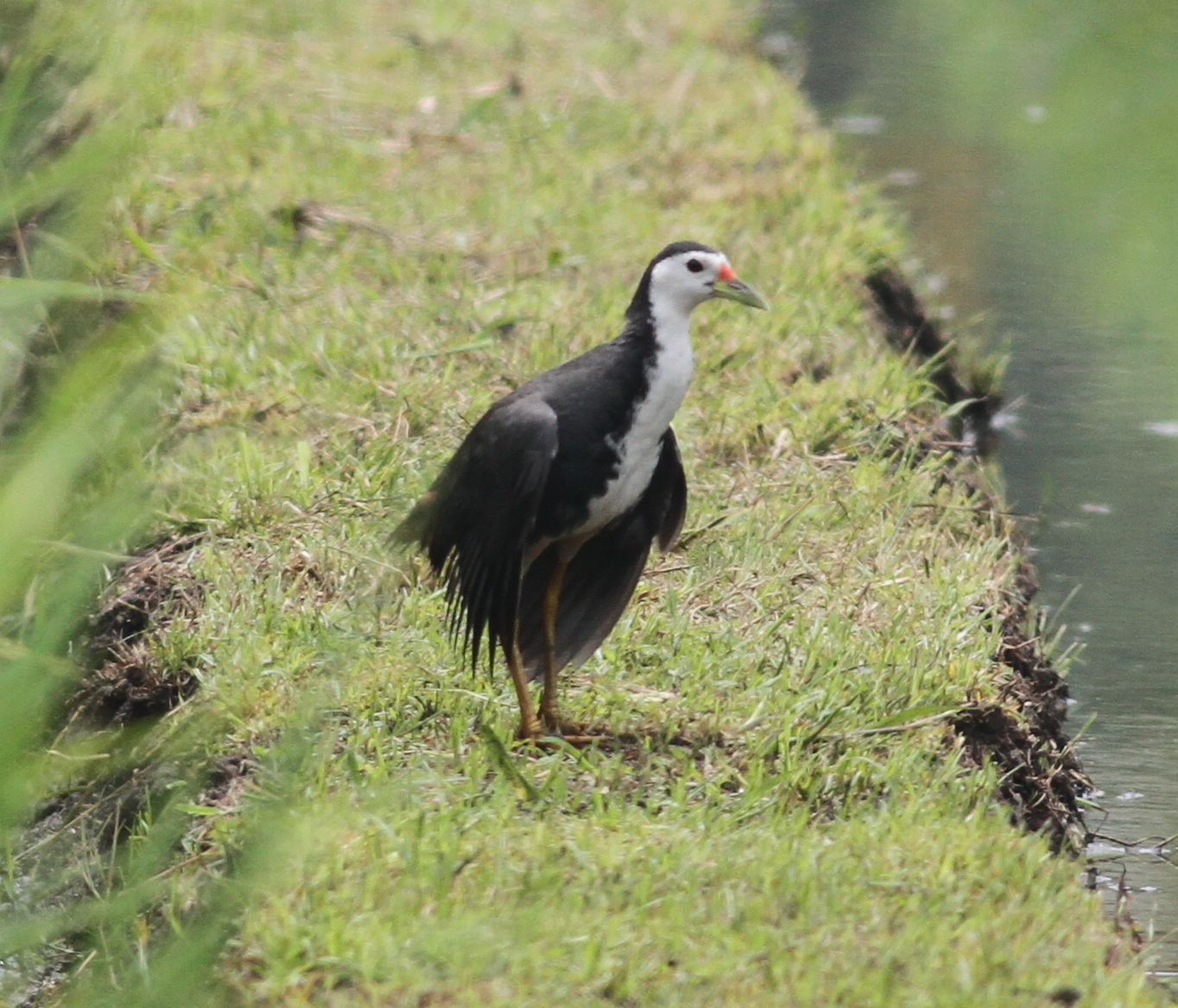
 White-breasted Waterhen.
Cinnamon Bittern appearing to be moulting into adult plumage.
One of a pair of Long-tailed Shrikes that have taken up residence in the lowland farm for the first time in at least 5 years.

Sunday, August 11, 2013

Week ending 11th August - IRRI

Back to the Philippines after our holiday, and lots of rain! The fields are very wet, and all the usual suspects are out and about. A surprise was a Little Grebe nest discovered by Richard soon after I got back. The nest was easy to find but it took me a while to locate the birds themselves. I eventually found an adult and two chicks.

Everything else is as normal. Lots of Rails and Painted Snipe around. Wood Sandpipers are starting to build up, but no other waders yet.

Little Grebe ssp philippensis with two chicks. The first time I've seen them at IRRI, though they have been reported, and photographed by others in my time here. Strangely elusive.
A Juvenile Black-crowned Night Heron by a rice paddy in the early morning.
Fan-tailed Cisticola
Male Painted Snipe...
...and a female.
White-throated/ Brown-breasted Kingfisher with a cloud of midges.
Buff-banded Rail
Common Moorhen


Friday, July 26, 2013

Wicklow Mountains - 26th July

On my last full day I decided to explore the Wicklow mountains area, and it was gorgeous. I shall have to return here as the birds were great. The streams held fairly easy-to-see Dippers, there were Ravens all over the place, Stonechats in the valleys, and a pair of Merlins showing very well at a conifer plantation.

A pair of Merlins were perched on a dead tree as soon as I arrived at the plantation area.                                                      
Dipper on one of the streams
Raven
 Small Tortoiseshell


Sunday, July 14, 2013

Loch Garten - 13 July

A trip to Crieff in Scotland to see some old friends was an opportunity to pop up to a spot I've long had on my list of birding spots I'd like to visit, Loch Garten and Speyside. It's the wrong time of the year for the true stars of the Caledonian Forest to be found, so no Capercailie, but there's plenty other birds of interest. The principal target here for me was Scottish Crossbill, which sadly I dipped on, but the Crested Tit were much more obliging, and I found them in a couple of places. The rest of the day's birding was fairly standard, though it was nice to find a pair of Great Spotted Woodpecker in beech woods along the edge of Loch Insh.

Crested Tit at a bird feeder by the RSPB hut at Loch Garten. Having said good morning to 5 RSPB staff as they arrived, and received 2 smiles, a grunt and a grumpy instruction to stand outside the gate until they were open I'd give the staff here a D+ for politeness.
The Tits on the other hand performed marvellously!
This scruffy Coal Tit got very close. This was by far the commonest of the 4 Tit species at the feeder. (Blue, Great, Crested & Coal)

Male Siskin.
Treecreeper.
Juvenile male Great Spotted Woodpecker at Loch Insh.
Several Red Squirrels were also attracted to the feeder,and were very confiding.