I took a day out from a family trip to Sabang on Mindoro to explore a golf course (Ponderosa) above Puerto Galera that was reputed to have some good habitat. A track leads from the ninth tee near the clubhouse towards a quarry, along a relatively undisturbed and little used muddy path. Straightaway the habitat looked great, and there was some early calls that were interesting. The main point of interest was a fruiting tree near the start of the track. It was here that I encountered the largest number, and greatest variety of birds. Mainly Mindoro Bulbuls at first, there were also Yellow-vented Bulbul, Bar-bellied Cuckoo-shrikes, Balicassiao, and Black-naped Monarch. A party of small passerines included several of the Arctic Warbler complex (still haven't got to grips with the 3 species that are said to occur here, Arctic, Japanese and Kamchatka Warblers), Lovely Sunbird, Elegant Tit, Pygmy Flowerpeckers, Orange-bellied Flowerpecker and my main target species of the day, Scarlet-collared Flowerpecker, a Mindoro endemic.
Another pleasing sighting was the distinctive all-black Mindoro race of Philippine Coucal. Interesting that both Coucals on this island that used to be known as the black island are all-dark, though the island name came from the particularly virulent strain of malaria that occurs here. Purple Needletails at the clubhouse were also nice, my second sighting of them in a week.
The site is a good one, and one that I'll visit again. I'm certain that Mindoro Hawk-Owl would occur, as well as the various Imperial Pigeon spp. and Parrots that occur on Mindoro.
And if anyone is wondering about the blood in the title of the post, its the three or four tablespoons I gave up to the 15 or so leeches that took me for a mobile buffet, not to mention the umpteen mosquitos, the bites of which are still making their presence felt.
The all-black Mindoro race of Philippine Coucal, Centropus viridis mindorensis. There were at least two in the upper stretch of the quarry trail, but were very wary, similar behaviour to their cousins in Luzon.
Orange-bellied Flowerpecker. This variable species has 11 races in The Philippines, 10 of them endemic. This is apparently Dicaeum trigonostigma xanthopygmium, the same race that occurs on Luzon. Its main distinguishing feature is its yellow rump.
Female Black-naped Monarch
Mindoro Bulbul
Wednesday, November 2, 2011
Sunday, October 30, 2011
Week ending 30th October - IRRI, Sabang
An interesting week. It started with a Red-necked Phalarope on the Experimental Farm on Tuesday afternoon. That had gone by the next day, leaving a Kentish Plover and two Long-toed Stints in its place. On my early morning run on Wednesday I heard the usual Philippine Hawk Owls, as well as a Philippine Nightjar in the staff compound, my first record there. Also on Wednesday a Philippine Scops Owl flew over my head as I was waiting in the IRRI car park to collect Fiona.
On Saturday we went to Sabang on Mindoro for a family/ diving holiday. The only birds on the way over were a flock of Common Terns.
Kentish Plover
Common Terns on the crossing from Batangas to Sabang
On Saturday we went to Sabang on Mindoro for a family/ diving holiday. The only birds on the way over were a flock of Common Terns.
Kentish Plover
Common Terns on the crossing from Batangas to Sabang
Tuesday, October 25, 2011
Red-necked Phalarope at IRRI
A big surprise this afternoon was a single Red-necked Phalarope on one of the paddies at IRRI. It was in company with a hundred or so Wood Sandpipers, a Long-toed Stint and a few dozen Little Ringed Plovers. They are regular migrants through the Philippines, but almost always offshore. They are pretty scarce inland, and this is certainly the first inland bird I've seen (or heard of since I came in 2008).
Monday, October 24, 2011
Week ending 23rd October - IRRI
Quite a productive week, with nice weather most days. On Monday a pair of Kentish Plovers had joined the wader flock on the farm, and were mixing with the LRPs, Wood Sandpipers and Long-toed Stints. They were no longer present on Wednesday. The conditions in the fields are perfect for Rallids, and many have been visible all week, often with youngsters in attendance. This seems to be the time of year to see Slaty-breasted Rails, which are visible daily.
On Saturday a fruiting tree on the UPLB section adjacent to the upland farms had flocks of Chestnut-cheeked Starlings, as well as plenty of other fruit-loving species, including a very obliging Striped Flowerpecker.
Barn Swallow posing nicely
Snipe sp. Either Pintail or Swinhoe's.
Pied Bushchat
Adult Slaty-breasted Rail. Very visible at the moment, I'm seeing them daily, similarly to last year. This means that they are either locally migratory (including youngsters), or after raising chicks to a certain size they become much less anxious about being seen.
Juvenile Slaty-breasted Rail
Kentish Plover
Pygmy Flowerpecker in the tree outside my front door
Striped Flowerpecker
On Saturday a fruiting tree on the UPLB section adjacent to the upland farms had flocks of Chestnut-cheeked Starlings, as well as plenty of other fruit-loving species, including a very obliging Striped Flowerpecker.
Barn Swallow posing nicely
Snipe sp. Either Pintail or Swinhoe's.
Pied Bushchat
Adult Slaty-breasted Rail. Very visible at the moment, I'm seeing them daily, similarly to last year. This means that they are either locally migratory (including youngsters), or after raising chicks to a certain size they become much less anxious about being seen.
Juvenile Slaty-breasted Rail
Kentish Plover
Pygmy Flowerpecker in the tree outside my front door
Striped Flowerpecker
Friday, October 21, 2011
Swifts, Swiftlets and Needletails
A short gallery showing a few of the commoner species of Swift that hang about Makiling.
The commonest Swiftlet in the area, the ubiquitous Glossy Swiftlet. The underparts can be almost white, and the white patch on the rump varies in size quite considerably. Only really confusable with Pygmy Swiftlet, which has a truly white rump (not the silvery grey shown here)
Asian Palm Swift. A bird with a rapidly changing flight profile
Purple Needletail. Enormous, and unmistakable. Much larger than all other Swifts in Luzon.
House Swift. Regularly seen over Baker Field in UPLB, but not so common elsewhere in the IRRI/ Makiling area.
The broad white rump is very clear in this species...
The commonest Swiftlet in the area, the ubiquitous Glossy Swiftlet. The underparts can be almost white, and the white patch on the rump varies in size quite considerably. Only really confusable with Pygmy Swiftlet, which has a truly white rump (not the silvery grey shown here)
Asian Palm Swift. A bird with a rapidly changing flight profile
Purple Needletail. Enormous, and unmistakable. Much larger than all other Swifts in Luzon.
House Swift. Regularly seen over Baker Field in UPLB, but not so common elsewhere in the IRRI/ Makiling area.
The broad white rump is very clear in this species...
Monday, October 17, 2011
Week ending 16th October - IRRI
More migrants in evidence this week, especially on the farms. New arrivals included a Common Kingfisher, Common Kestrel and Peregrine on Saturday. The latter quite possibly the same bird that was present most of last winter, though if it is it has arrived much earlier than last year (mid November). Several Long-toed Stints still around, along with lots of Little Ringed Plovers. Also plenty of Yellow and Grey Wagtails.
Plenty of young Rallids around as well this week, with juvenile Buff-banded and Slaty-breasted Rails to go with the White-breasted Waterhen and Moorhens that have been visible for a while.
| Juvenile Buff-banded Rail |
| Buff-banded Rail |
| Juvenile Slaty-breasted Rail |
| Peregrine, back on the same pylon as last winter, but quite a bit earlier. |
| Painted Snipe hiding in a paddy |
| Long-tailed Shrike |
| Whiskered Tern |
Sunday, October 9, 2011
Week ending 9th October - IRRI
The Philippines was still dealing with the after-effects of
two typhoons in a week, so it was a blustery and wet week. I did manage a
couple of hours on the farms however, and the passage of Black-winged Stilts
continues, with several small groups scattered about the paddies. Long-toed
Stints are also moving through, with two small groups of 10+ birds present on
Tuesday. Slaty-breasted Rail are
now visible on practically every visit too.
The main excitement of the week was the fruiting of a large
tree adjacent to the main gate at IRRI staff housing at the weekend. Lots of
Lowland and Yellowish White-eyes, Yellow-vented Bulbuls, and flocks of
Flower-peckers were augmented by large groups of newly arrived Chestnut-cheeked
Starlings. A small flock of Philippine Green Pigeons were also present on
Sunday.
Lowland White-eye.
Grey-streaked Flycatcher
Juvenile Chestnut-cheeked Starling
Chestnut-cheeked Starling
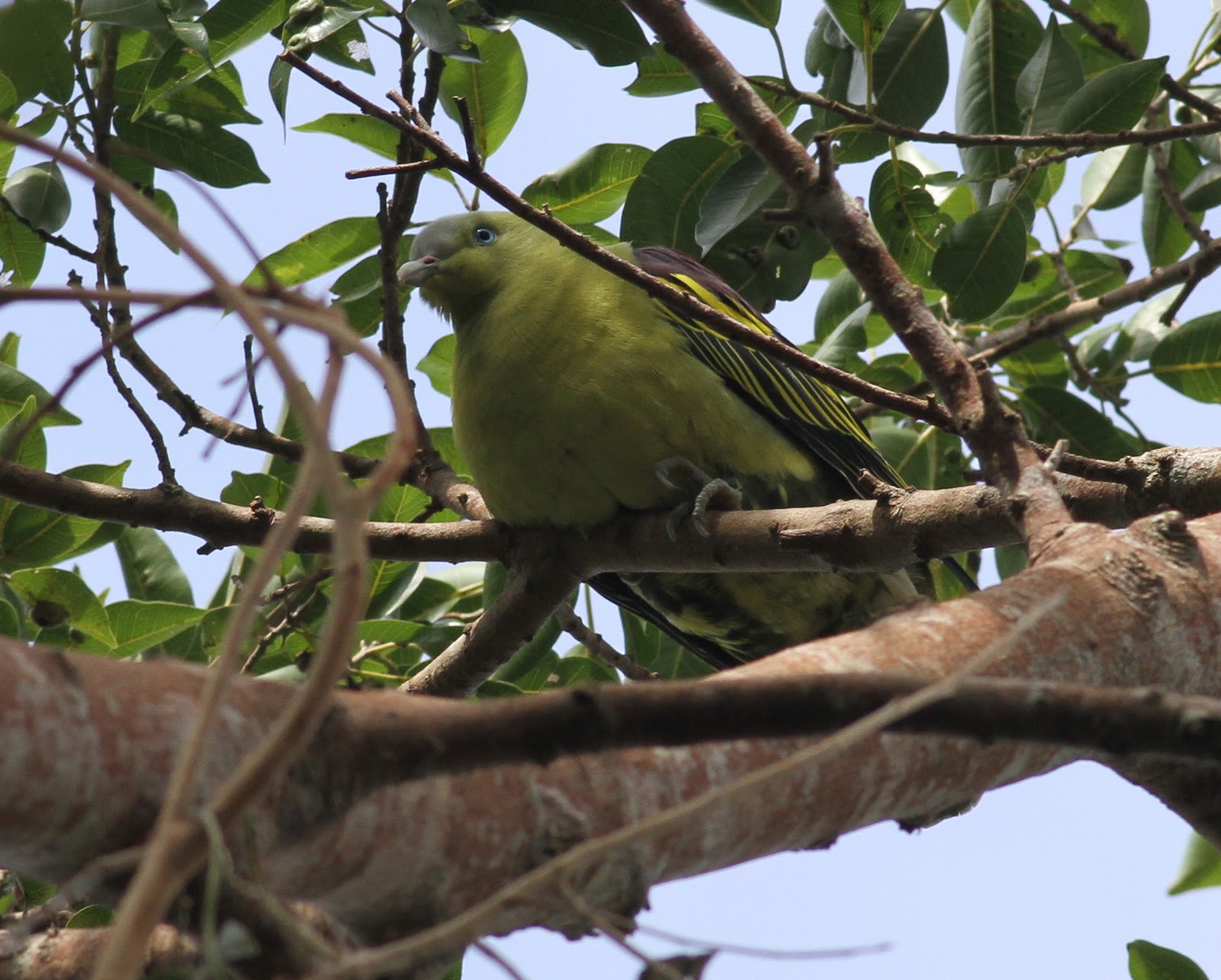
Philippine Green Pigeons Treron axillaris, recently split from Pompadour Green Pigeon Treron pompadora. According to Collar (2011) this differs from the races of T. pompadora in Vietnam, T. p. phayeri and India, T. p. affinis "on account of their red cere" (see second photo) "white (not creamy-brown) undertail coverts" (photo 3) "bluish grey (not pinkish red) legs and feet" and "lack the orange breast patch" (all pictures). In addition differs from phayeri in "maroon (not chestnut) back" and from affinis in "much less distinctive yellow throat". To me the eye seems distinctly pale blue, compared to the darker blue of T. pompadora.
Subscribe to:
Posts (Atom)