I took the opportunity to make a flying visit to Siburan while staying on nearby Pandan Island. A permit is required from the tourism authority in Sablayan (09294280431 or 09159953895), who will also provide you with a guide to take you to the prison. Once there it is a quick matter to hire an inmate (I had Archie again), and then it's birding time. The birds were tough as always here, and it took a while before we saw anything. The main target species here is the Mindoro endemic Black-hooded Coucal, of which we eventually heard about 10 birds, and had a brief glimpse of one. A similar story can be told about the Blue-crowned Racquet-tails, one bird briefly glimpsed while being surrounded by a flock calling very raucously. There were other birds of course. Philippine Fairy Bluebirds are quite common here in the taller trees. I also had the mindorensis race of Bar-bellied Cuckoo-Shrike, and a migrant Oriental Cuckoo.
All in all not an easy day's birding, but worth the detour!
Oriental Cuckoo
Whiskered Tree-Swift
Bar-bellied Cuckoo-Shrike, ssp. mindorensis
Sunday, December 30, 2012
Wednesday, December 19, 2012
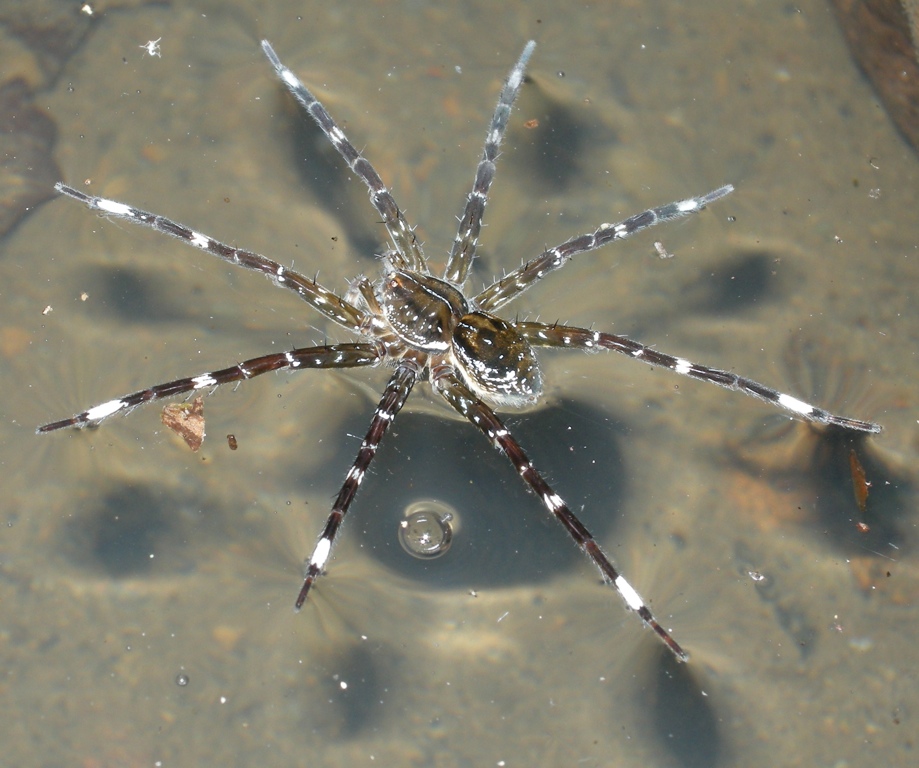
Fishing Spiders - 19th December
These first two were close together on the water. They are quite different to look at, but are almost exactly the same size, and I took them to be the same species, possible a male and female?
This is a Fishing Spider, Thalassius albocinctus. I found these a number of times while living in Lao PDR. Quite a different structure from the two in The Philippines. The legs in particular are quite different; being more flat to the surface of the water, of more even lengths, and more evenly spaced. This species is said to occur in The Philippines as well, however the above photographs show a spider of a different structure, which surely must be a different species.
Friday, December 14, 2012
Makiling Botanical Gardens - 14th Dec
A nice afternoon spent at the Botanical Gardens and on the IRRI farms in the company of visiting birder Lawrence. We started at the Botanical Gardens, the Forest Wagtail of last week seems to have gone, but the male Indigo-banded Kingfisher was on post, sitting in the gloom upstream of the weir. At the bridge itself a couple of Flycatchers were diverting At first I thought I was looking at the Ashy-breasted seen a couple of weeks ago, but the prominent eye-ring and dark tip to the bill signaled this was in fact an Asian Brown Flycatcher. A Grey-streaked Flycatcher appeared nearby for a direct comparison.
There was not much else on view so we moved on to the fields at IRRI. The Peregrine was still on station on the pylons, and a pair of Buff-banded Rails were escorting three tiny bundles of black fluff that were their chicks. The upland farm had large numbers of Yellow Wagtails, as well as a solitary Purple Heron. A brown shape diving into the long grass hear the top of the farm was very intriguing. The prime candidates have to be either a large plain locustella warbler, or a Siberian Rubythroat. I shall have to go back...
The prominent white eye-ring on this Asian Brown Flycatcher is the easiest way of separating it from Ashy-breasted Flycatcher...
There was not much else on view so we moved on to the fields at IRRI. The Peregrine was still on station on the pylons, and a pair of Buff-banded Rails were escorting three tiny bundles of black fluff that were their chicks. The upland farm had large numbers of Yellow Wagtails, as well as a solitary Purple Heron. A brown shape diving into the long grass hear the top of the farm was very intriguing. The prime candidates have to be either a large plain locustella warbler, or a Siberian Rubythroat. I shall have to go back...
The prominent white eye-ring on this Asian Brown Flycatcher is the easiest way of separating it from Ashy-breasted Flycatcher...
Wednesday, December 5, 2012
Makiling Botanical Gardens - 5th Dec
Having heard about a sighting of Ashy-breasted Flycatcher in the Botanical gardens at Makiling last weekend I have been shooting back from work every day trying to catch sight of this elusive endemic. The first bird I saw on Monday was a Forest Wagtail, my second of the winter. It was present each day thereafter, and hopefully will hang around long enough to get some decent photographs. A pair of Indigo-banded Kingfishers also showed well on Monday and Tuesday, but nos sign of the Flycatcher yet. I plan to take another shot this weekend!
Indigo-banded Kingfisher near the bridge in the Botanical Gardens.
This looks like a different bird, in a very similar spot to the first, a few minutes later. The red loral spot as well as the brighter red mandible look different from the first bird, but are not indicators of sex, that is restricted to the breast bands (2 for males, one for females). It is of course possible that the differences are down to lighting and angle of view!
My second Forest Wagtail of the winter. They have been seen in a couple of other places this winter (La Mesa Eco Park for example), so maybe there's an influx this year. This was present on Monday, Tuesday and Wednesday this week, each time in company with a Grey Wagtail. It is a much less confiding bird however, being very hard to approach.
Indigo-banded Kingfisher near the bridge in the Botanical Gardens.
This looks like a different bird, in a very similar spot to the first, a few minutes later. The red loral spot as well as the brighter red mandible look different from the first bird, but are not indicators of sex, that is restricted to the breast bands (2 for males, one for females). It is of course possible that the differences are down to lighting and angle of view!
My second Forest Wagtail of the winter. They have been seen in a couple of other places this winter (La Mesa Eco Park for example), so maybe there's an influx this year. This was present on Monday, Tuesday and Wednesday this week, each time in company with a Grey Wagtail. It is a much less confiding bird however, being very hard to approach.
Saturday, November 24, 2012
Candaba - 24th Nov
A good day at Candaba with Mark Wallbank. We got there just after sunrise on a very sunny and cloudless morning which turned out to be an absolute scorcher. There was a lot of water around, with large expanses of flooded grassland. The ricefields were being prepared for the next crop, and many were in the process of being ploughed leaving large expanses of wet mud. This activity was attracting huge numbers of birds, particularly all the Egrets (Great, Intermediate, Little and Cattle), Whiskered Terns and Barn Swallows all of which were very numerous in the farmed areas. The muddy fields were not as productive for waders, with the only birds present
being Black-winged Stilt (100+), Wood Sandpiper, Long-toed Stint (1),
Greenshank (5) and Snipe sp (10+).
The flooded grassland had a huge flock of ducks. We estimated at least 10,000 birds. The largest proportion were Garganey (5000+), with Philippine Duck (4,000+), Tufted Duck (200+) and Shoveller (200+) making up the rest. There were only a few individuals of other species, with a dozen or so Eurasian Teal, 3 Pintail and a lone female Wigeon.
Other migrants included a pair of White-shouldered Starlings were near the mayor's house and several Arctic Warblers in the trees.
Aside from this Candaba was its usual self, with amazing numbers of roosting Grey Heron, Purple Heron and Black-crowned Night-Heron around the mayor's pond, and loads of rallids including Barred Rail, Buff-banded Rail, White-browed Crake, White-breasted Waterhen, Purple Swamp-Hen and Common Moorhen. Yellow Bitterns were in good numbers, but only one Cinnamon Bittern.
Male Red Turtle Dove. Loads of these beautiful doves today.
Oriental Reed Warbler
Juvenile Lesser Coucal catching the early morning sun
Zebra Doves
Part of a large concentration of Egrets. Great, Intermediate and Little Egrets here in big numbers, with plenty of Cattle Egrets as well.
(Philippine) Purple Swamp-Hen
Wandering Whistling Duck
Purple Heron
Part of a huge flock of duck. Mostly wintering Garganey, there was also a large proportion of resident Philippine Duck, as well as a few other species.
Arctic Warbler
The tail-end of a snake crossing our path on the way out
The flooded grassland had a huge flock of ducks. We estimated at least 10,000 birds. The largest proportion were Garganey (5000+), with Philippine Duck (4,000+), Tufted Duck (200+) and Shoveller (200+) making up the rest. There were only a few individuals of other species, with a dozen or so Eurasian Teal, 3 Pintail and a lone female Wigeon.
Other migrants included a pair of White-shouldered Starlings were near the mayor's house and several Arctic Warblers in the trees.
Aside from this Candaba was its usual self, with amazing numbers of roosting Grey Heron, Purple Heron and Black-crowned Night-Heron around the mayor's pond, and loads of rallids including Barred Rail, Buff-banded Rail, White-browed Crake, White-breasted Waterhen, Purple Swamp-Hen and Common Moorhen. Yellow Bitterns were in good numbers, but only one Cinnamon Bittern.
Male Red Turtle Dove. Loads of these beautiful doves today.
Oriental Reed Warbler
Juvenile Lesser Coucal catching the early morning sun
Zebra Doves
Part of a large concentration of Egrets. Great, Intermediate and Little Egrets here in big numbers, with plenty of Cattle Egrets as well.
(Philippine) Purple Swamp-Hen
Wandering Whistling Duck
Purple Heron
Part of a huge flock of duck. Mostly wintering Garganey, there was also a large proportion of resident Philippine Duck, as well as a few other species.
Arctic Warbler
The tail-end of a snake crossing our path on the way out
Saturday, November 17, 2012
Banahaw - 17 Nov
We headed down at about midday, with not much to be seen until we got almost to the village where we encountered another flock. This time it was mainly Flowerpeckers (Orange-bellied and Buzzing), Arctic Warbler and Metallic-winged Sunbird. As we left the flock we spotted a male Narcissus Flycatcher immediately above us. Assuming this bird was the last hurrah we started down the final stretch of trail when Chris motioned me to stop. Low down, just off the trail we saw movement. At first it was impossible to tell what was there, as we waited we got tantalising glimpses, but they added up to a real mystery. Eventually it transpired that there were at least 4 birds of 2 species, in an area of forest about 4mx4mx4m. The initial bird was a female Snowy-browed Flycatcher, a male showed briefly, as did a second female (or juvenile male). The fourth bird was a Green-backed Whistler.
I'm not sure whether this is a female or a juvenile. It has a clearly greyish head compared with its back, different from the third bird in this set.
And a male nearby. He didn't hang around long.
This is definitely a female
Green-backed Whistler
Male Narcissus Flycatcher
Female Metallic-winged Sunbird
Philippine Serpent-Eagle
Saturday, November 10, 2012
IRRI - 10th Nov
My planned forest visits were scuppered by a lack of appropriate transport, so birding was restricted to a quick trip to the fields on Saturday. The most interesting bird was the Peregrine which has reappeared for the first time this winter. Previous early dates were 15 Oct in 2011, and 21 Nov in 2010.
Not much else about. A Bright-capped Cisticola coming into breeding plumage was an unusual sight in midweek.
Peregrine, F. peregrinus calidus, a common winter visitor in The Philippines....
... which is very different from the much smaller resident race, F. p. ernesti. This one was photographed on a high-rise block of flats in Manila.
Long-tailed Shrike
Bright-capped Cisticola.
Not much else about. A Bright-capped Cisticola coming into breeding plumage was an unusual sight in midweek.
Peregrine, F. peregrinus calidus, a common winter visitor in The Philippines....
... which is very different from the much smaller resident race, F. p. ernesti. This one was photographed on a high-rise block of flats in Manila.
Long-tailed Shrike
Bright-capped Cisticola.
Subscribe to:
Posts (Atom)