Thursday, July 12, 2012

Etosha, 6 - 9 July

After leaving Khamanjab we entered Etosha at Okakuejo, and drove east to our camp at Halali. We spent two nights there, then two further nights at a camp just outside the gate at Namatoni. Our last two nights in Namibia were in Bushmanland at Tsumkwe, near the Botswana border.

The birding changed between Halali and Namatoni. In Halali there were still a few Namibian specials, specifically Violet Woodhoopoe and Bare-cheeked Babbler (though I failed to find the latter at this site), by the time we got to Namatoni these had disappeared, being replaced by birds more common in the east. The camp staff at Halali have two or three owl species staked out, and it's well worth asking where the roosts are. Other birds of note included Kori Bustard and Red-crested Korhaan.

From a mammal perspective it was a great trip. The grass was still long which made it hard to find some things, and the waterholes were fairly full, meaning that the game was not as concentrated as it might be, but it was still brilliant. We saw Lion on every drive, and a good selection of plains game at almost every waterhole. Variety was less than similar parks elsewhere in Africa, but the size of the herds, and the ease with which we found predators made this a minor niggle. Elephant were strangely absent, with only one male being seen, though sign of their presence was everywhere. The star mammals for me were undoubtedly the Black Rhinos which are easier to see here than anywhere else in the world.Our mammal list included (Angolan) Giraffe, Black-faced Impala, Gemsbok, Springbok, Steenbok, Damara Dik-Dik, Red Hartebeeste, Blue Wildebeeste, Burchell's Zebra, Black Rhino, Elephant, Warthog, Kudu, Lion, Black-backed Jackal, Spotted Hyena, Black-tailed Scrub Hare, Ground Squirrel, Mopane Tree Squirrel, Banded Mongoose and Large-spotted Genet.

We didn't get around to any night-drives, way too expensive, but we were treated to a visit in our camp at Namatoni gate by a Large-spotted Genet, as well as Black-backed Jackal.

Tsumkwe was also interesting, with the pans at Nyae-nyae being full to the brim, with breeding flocks of both Greater Flamingo and Lesser Flamingo. Lots of other waterbirds, including a surprise Slaty Egret on one of the smaller pans in the area, and a Bradfield's Hornbill on the Maun road.

African Scops Owl roosting in Halali camp. Wonderfully chamouflaged, I would never have found this without help.
Roosting Barn Owls, also in Halali.
Double-banded Sandgrouse, male...
...and female.
Violet Woodhoopoe. Easy to find in the grounds of Halali.
Meyer's Parrot, which replaces Ruppell's parrot somewhere between Halali and Namatoni.

Southern White-crowned Shrike.
Crimson-breasted Shrike. Very common, but always a treat to see.
Kori Bustard. Another bird which always gives me a thrill.
This strangely marked Burchell's Zebra stood out like a sore thumb, surely a dangerous trait in a land with so many predators...
Damara Dik-Dik. A wonderful new antelope for me. The oddest thing to me is the strange, almost mini trunk-like nose.
This large female Lion was part of a group of five which killed a Gemsbok a few minutes before we arrived at the pan. She is so fat she may even be pregnant as well!
Black-faced Impala.
It was fantastic to see Black Rhino again, it's been many years since I saw one in the wild, possibly not since I was a child in Luangwa...

Thursday, July 5, 2012

Namibian Escarpment, 1 - 5 July

After leaving the coast at Henties Bay we drove inland to Brandberg, where we camped for a couple of days. We hiked into a canyon to view the rock art there, particularly the White lady painting. Our next stop was on the Huab river at Aba Huab for a day, followed by two days at Khamanjab, just south of the western gate to Etosha.

Birding was great in this area, with Hornbills appearing, as well as more bushveld type species, and a different suite of Larks. Endemics and near-endemics included Hartlaub's Francolin, Damara Red-billed Hornbill, Monteiro's Hornbill, Bare-cheeked Babbler, White-tailed Shrike, Benguela Long-billed Lark, Ruppell's Parrot and Chestnut Weaver (sadly in non-breeding plumage). Other birds of note included Double-banded Courser, Barred Wren-warbler, and the pale Namibian races of Tractrac Chat and Karoo Chat. 

Mammals were less plentiful in this unprotected area, though I did add Dassie-Rat to my mammal life-list, as well as several reptiles.

 
Barred Wren-warbler
Benguela Long-billed Lark, at almost the southern limit of its distribution, just south of Brandberg. Separated from the Karoo Long-billed Lark by a noticeably shorter bill.
Damara Red-billed Hornbill. A very white head and dark eye separate this new split from the Red-billed Hornbill elsewhere in southern Africa.
Female Hartlaub's Francolin, my last Francolin spp. for southern Africa. we encountered this hard to find bird on the road north from Aba Huab to Khamanjab, and also at the farm where we camped in Khamanjab.
And a male nearby...
Monteiro's Hornbill. A common and noisy resident of the campsite at Brandberg.
Tractrac Chat ssp. hoeschi (or possibly albicans. My version of Howard and Moore allocate albicans to "N coastal Namibia" and hoeschi to "S Angola, N Namibia")
White-quilled Korhaan.
White-tailed Shrike. Common as soon as we hit Mopane woodland.
Boulton's Namib Day Gecko. A few kilometres east and north of Brandberg.
Giant Plated Lizard.

Namibian Rock Agama, female...
...and a young-looking male (the body of an adult male is quite blue)
A herd of Gemsbok in one of the 900 rock paintings at Brandberg.
And a Red Hartebeeste at the same site.

Saturday, June 30, 2012

Namib Naukluft, 26 - 30 June

As our summer holiday this year we decided to head back to southern Africa, and do a tour of Namibia.We went the camping route, as there's really no alternative in Namibia, and my brother organised the itinerary. Namibia has a healthy selection of endemics, as well as a lot of fascinating wildlife, and it has been top of my list of must-visit countries for a long time. After driving to Windhoek via Botswana and the Trans-Kalahari Highway we headed south to the Namib-Naukluft N.P. camping outside Sossusvlei, and on the Kuiseb River at Homeb. We then spent a couple of days at Swakopmund, before travelling inland towards the Namibian escarpment.

There was a fair bit of general plains game outside reserves, mainly Springbok and Gemsbok, along with Rock Hyrax, Ground Squirrels and Black-backed Jackal. A Round-eared Elephant-Shrew near our camp was a lifer mammal. The birding was sparse but interesting, with highlights including endemics such as Dune Lark, Stark's Lark, Ruppell's Korhaan and Rosy-faced Lovebird. Other notable birds included Ostrich and Ludwig's Bustard. Sociable Weaver nests were numerous, as were Pale Chanting Goshawk on every second tree it seemed.

On the way inland we made a detour to Cape Cross to see the Cape Fur Seal colony. Between 80,000 and 100,000 seals are present year round, attracting a variety of predators, those we saw included Black-backed Jackal, Kelp Gull and a Giant Petrel spp. Also offshore were many Cape Gannets and several White-chinned Petrel.

One of the main target species in the Namib-Naukluft area is Dune Lark. It was elusive at first, but once I caught up with one it was very confiding.

This area of Namibia is said to have one of the last populations of genetically pure Ostrich, untainted by mixing with domestic stock.
Ruppell's Korhaan were common. While they can be cryptic, their habit of calling in a particularly raucous fashion every morning ensured we saw them daily in suitable habitat.
Stark's Lark. Surprisingly hard to locate on the gravel plains, particularly when time was a factor.


Female Grey-backed Sparrow-Lark, causing a brief identification challenge.
Sociable Weaver nest near our camp, a big one!
This Gemsbok posed very nicely at dune 45.
Zebra Pan one the way to Homeb. Very little water in this area, so any regular supply attracts game.


What I took to be a fight between two young male Cape Fur Seals. An excellent detour, and not as smelly as we'd been led to believe...


Springbok are ubiquitous throughout Namibia.

 Ground Squirrel, common throughout Namibia

Cape Gecko underneath the sink in the campsite ablution block.

Monday, June 11, 2012

Puerto Princesa - 11th June

My last morning on Palawan, and I decided to bird around the airport. Puerto Princesa is a very forested city, and very birdy. The end of the runway sticks out into the sea a little, and the flats here had Grey-tailed Tattler, Whimbrel, Lesser Sandplover and Ruddy Turnstone, with Great Egret and Little Egret in the shallows offshore. The trees along the road adjacent to the airport had Pink-necked Green Pigeon, Black-headed Bulbul, White-vented Shama and Palawan Flowerpecker.

Pink-necked Green Pigeon. A male feeding two insistent youngsters.
Black-headed Bulbul.Fairly common throughout Palawan.
Male Palawan Flowerpecker. One of the more spectacular flowerpeckers, this is very common.
Palawan Bulbul, Alophoixus frater. Recently split from Grey-cheeked Bulbul, another new Palawan endemic...

... as is Ashy-fronted Bulbul, Pycnonotus cinereifrons. 
White-vented Shama. One of a small number of birds at every site, this individual is doing what this species does best, sing its heart out!

Zigzag Road - 10th June

The fourth and final stop on my Palawan adventure. Zigzag Road is the name given to a stretch of diused road about 34km south of Puerto Princesa. The road itself is easy to find, just after the 34km marker going up to the right hand side of the main road. It was brilliant, and I should have budgeted more time here, I'm sure it would have produced more birds. My main target here was what was turning out to be a real bogey bird, Blue Paradise Flycatcher. I just hadn't been able to find it at Sabang or Iwahig. 2 minutes out of the van on Zigzag however, and there is the call! It responded immediately, and aggressively to playback, and I had a fantastic male in the bins! After that the birding continued very well. More calling Melodious Babbler, a very obliging Spot-throated Flameback, as well as Chestnut-breasted Malkoha (2), Dollarbird (2), calling Hooded Pitta (3+) with one visible, Yellow-throated Leafbird, Ashy-fronted Bulbul, Ashy Drongo, Hair-crested Drongo, Pin-striped Tit-Babbler and Rufous-tailed Tailorbird.

Spot-throated Flameback, Dinopium everetti. A recent split from Common Flameback, this is another 'new' Palawan endemic.
 Chestnut-breasted Malkoha, ssp. harringtoni. Not easy to find, but very smart.
Blue Paradise Flycatcher. At last! This female was further up the road than my first bird. They proved to be quite common, with at least 4 calling birds in a 1 km stretch of road.

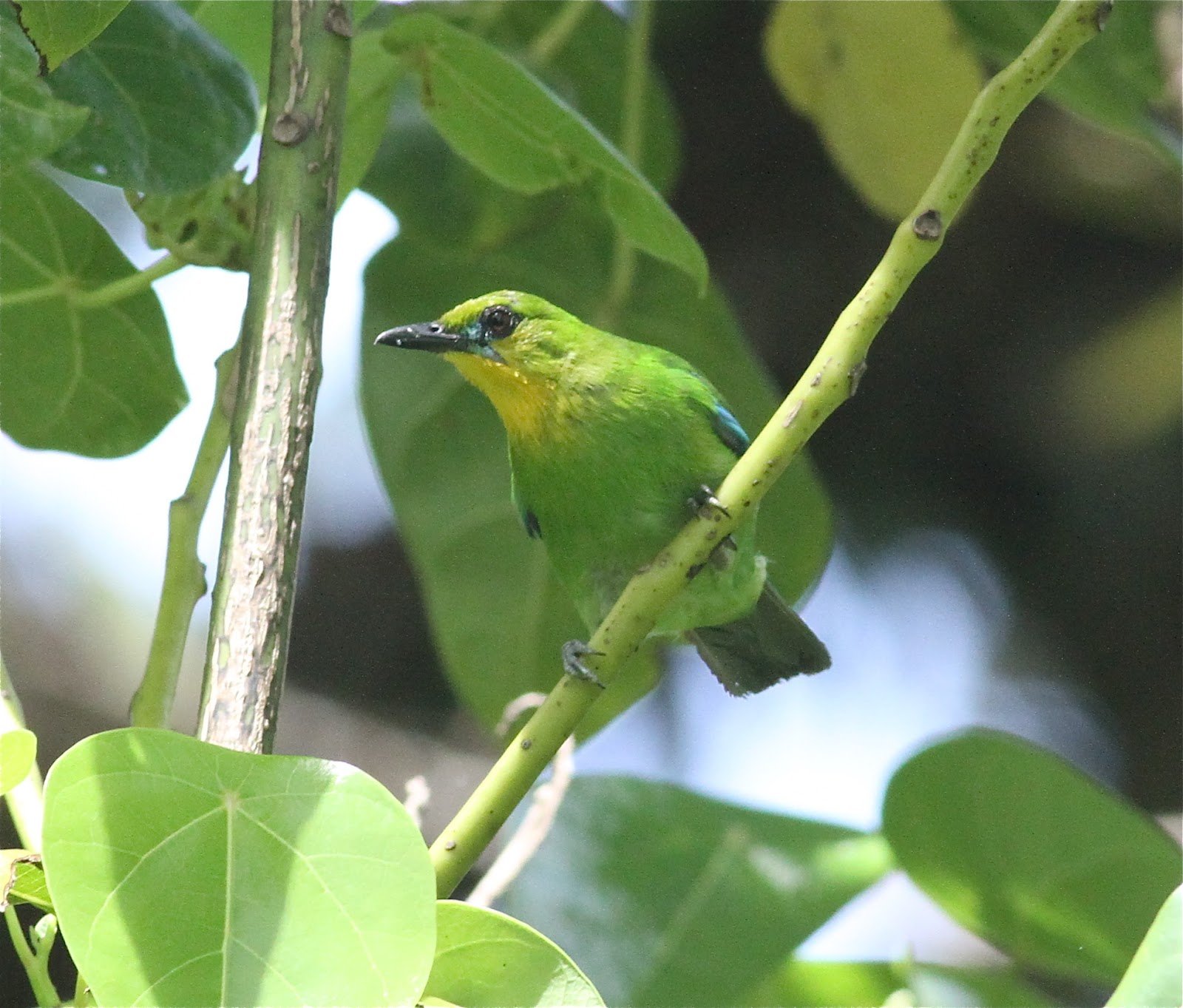
Yellow-throated Leafbird. Still one of my favourite Asian bird families.
Hair-crested Drongo, ssp. palawanensis. A very chunky bird, certainly when compared to ...
 Ashy Drongo.Very slender for a drongo.
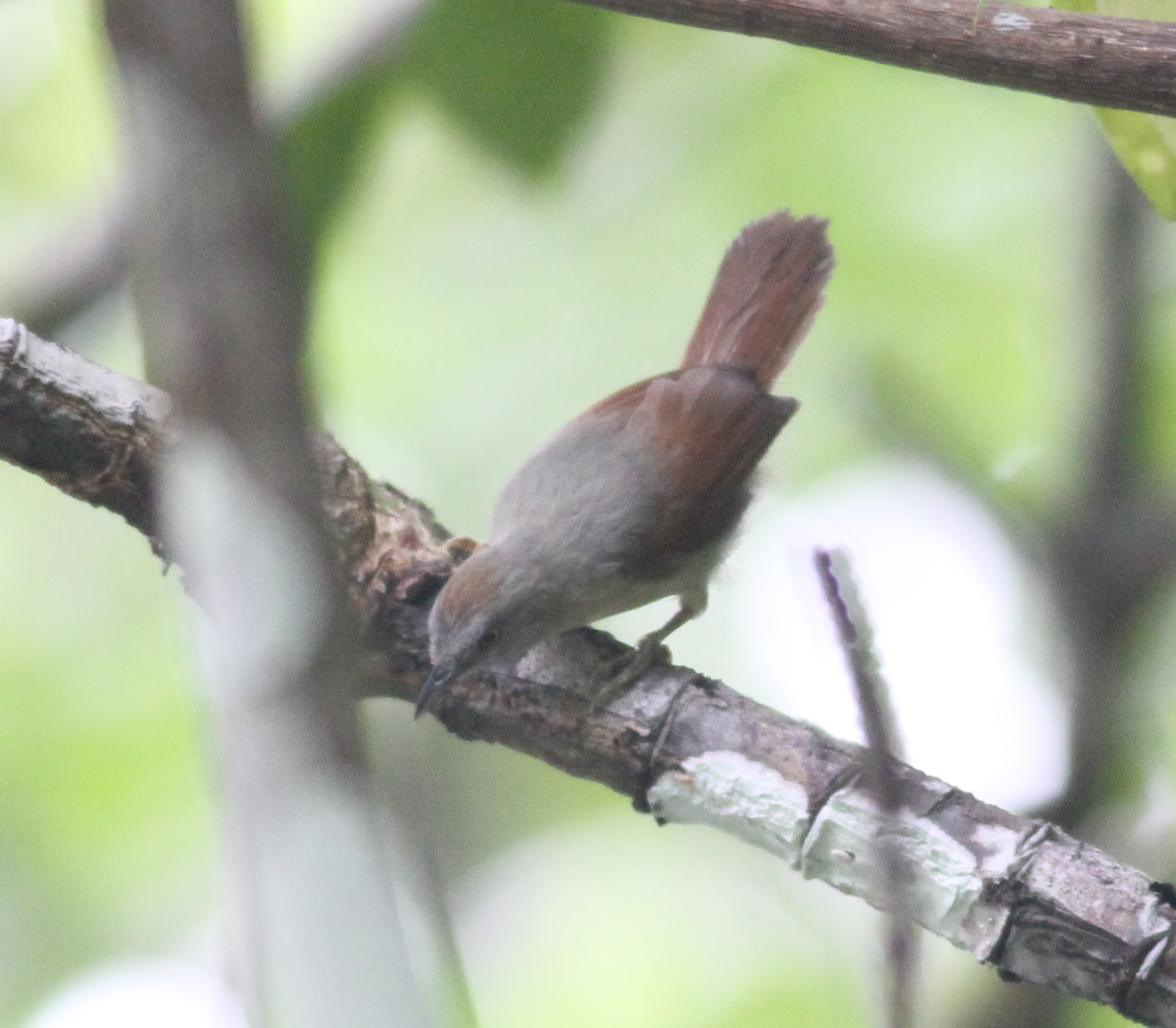
Rufous-tailed Tailorbird. Common, but tricky to see.

Pin-striped Tit-Babbler, Macronus gularis, ssp. woodi. Another recent split, from Bold-striped Tit-Babbler.

Iwahig - 9th June

For the third leg of my trip I stayed at a hotel in Puerto Princesa (Badjao Inn, 993 pesos/ night including AC). I hired a van and driver (from Estrelita Alejandria - 0920 295 3178) and on the morning of 9th I went to Iwahig. The guide was nice enough, but not particularly knowledgable, and spoke little English besides, so I was on my own, which is fine.

The first bird was a calling Hooded Pitta, which showed well, but only in silhouette so the photographs were poor. The trail is not long, but we took our time and had a pleasant morning. Most notable of the early birds was a couple of Melodious Babbler, which responded aggressively to playback, but were very shy to show themselves. When I finally did get eyes on them I was stunned to see how bulbul-like they were, I in fact dismissed one as a bulbul until my brain kicked in and I realised there were no brown bulbuls with white throats on Palawan (inlike Thailand where there are about 5!).

I also had good views of Spot-throated Flameback (1), Palawan Hornbill (2), Green Imperial Pigeon (3) and Crested Goshawk (1). At a spot towards the end of the trail its possible to sit by a stream, in a clearing. From here I had 3 different Hooded Pittas calling around me, as well as fly-over Blue-naped Parrots (4), a confiding male Black-naped Monarch and another Stork-billed Kingfisher.

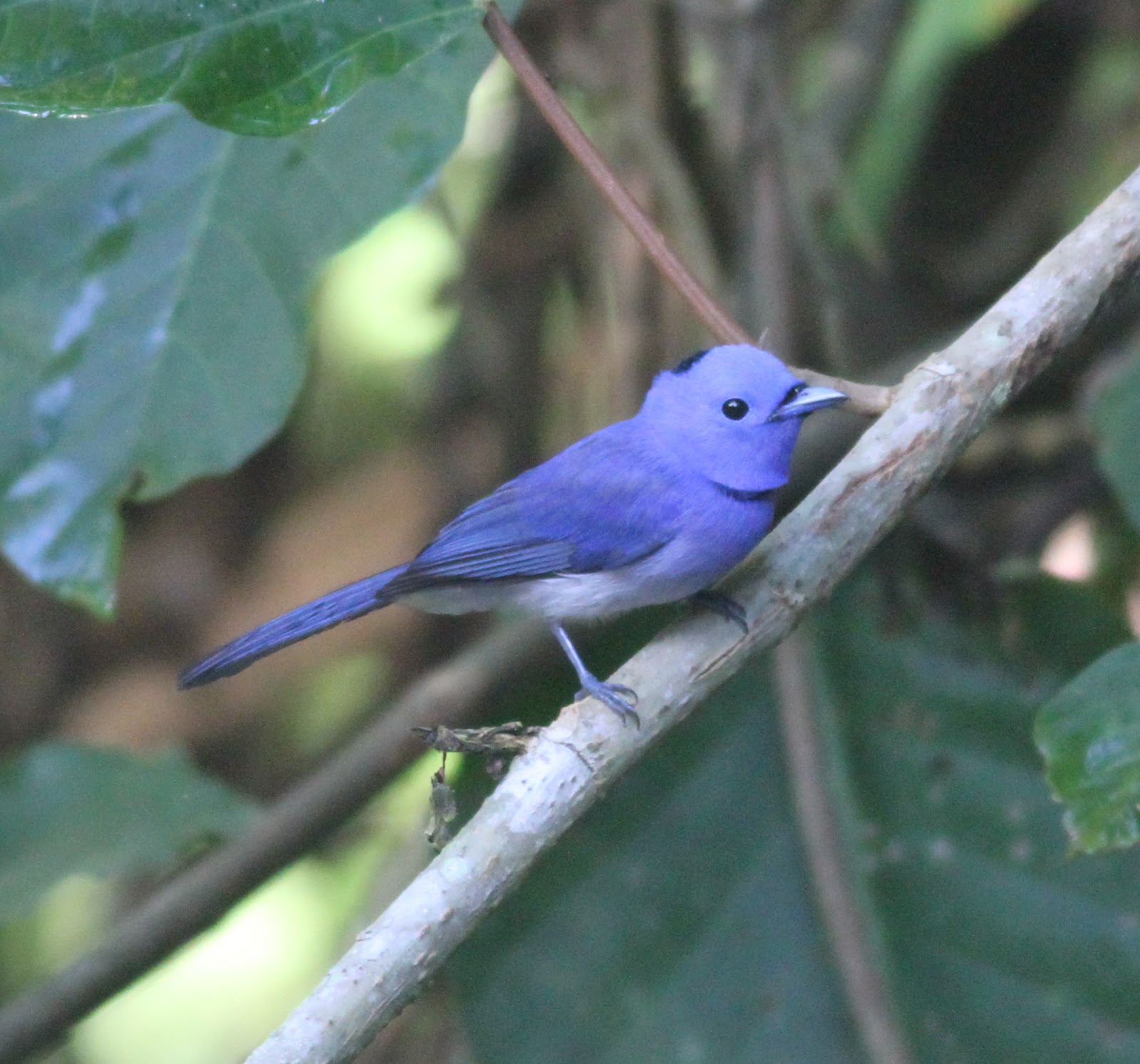
Black-naped Monarch. This cracking male was quite unconcerned by my presence!
Green Imperial Pigeon, ssp. palawanensis. Fairly common throughout the forest on Palawan, but always wary.

Palwan Hornbill. One of the great Asian hornbills.


Small frog. By the stream.