My last morning on Palawan, and I decided to bird around the airport. Puerto Princesa is a very forested city, and very birdy. The end of the runway sticks out into the sea a little, and the flats here had Grey-tailed Tattler, Whimbrel, Lesser Sandplover and Ruddy Turnstone, with Great Egret and Little Egret in the shallows offshore. The trees along the road adjacent to the airport had Pink-necked Green Pigeon, Black-headed Bulbul, White-vented Shama and Palawan Flowerpecker.
Pink-necked Green Pigeon. A male feeding two insistent youngsters.
Black-headed Bulbul.Fairly common throughout Palawan.
Male Palawan Flowerpecker. One of the more spectacular flowerpeckers, this is very common.
Palawan Bulbul, Alophoixus frater. Recently split from Grey-cheeked Bulbul, another new Palawan endemic...
... as is Ashy-fronted Bulbul, Pycnonotus cinereifrons.
White-vented Shama. One of a small number of birds at every site, this individual is doing what this species does best, sing its heart out!
Monday, June 11, 2012
Zigzag Road - 10th June
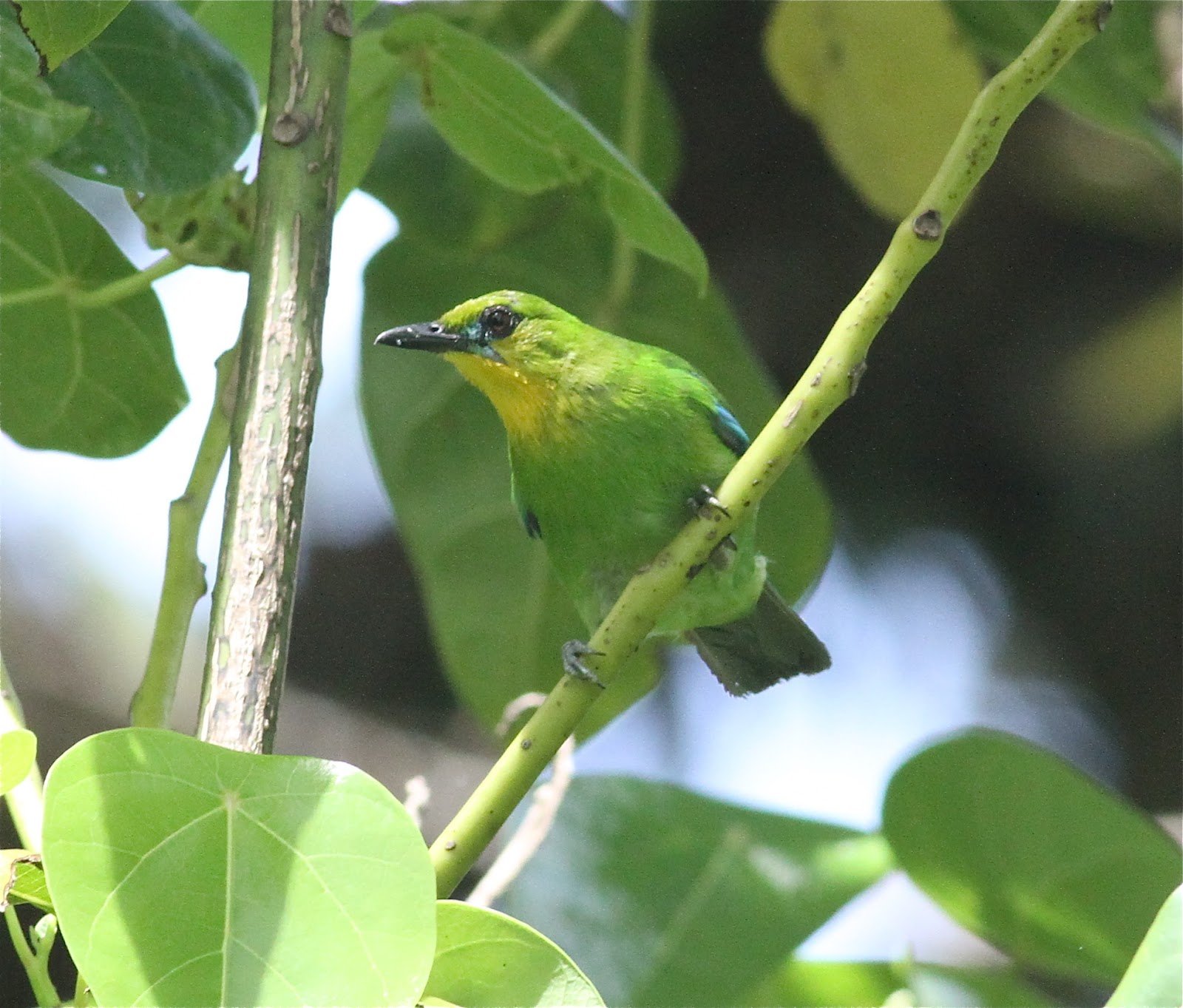
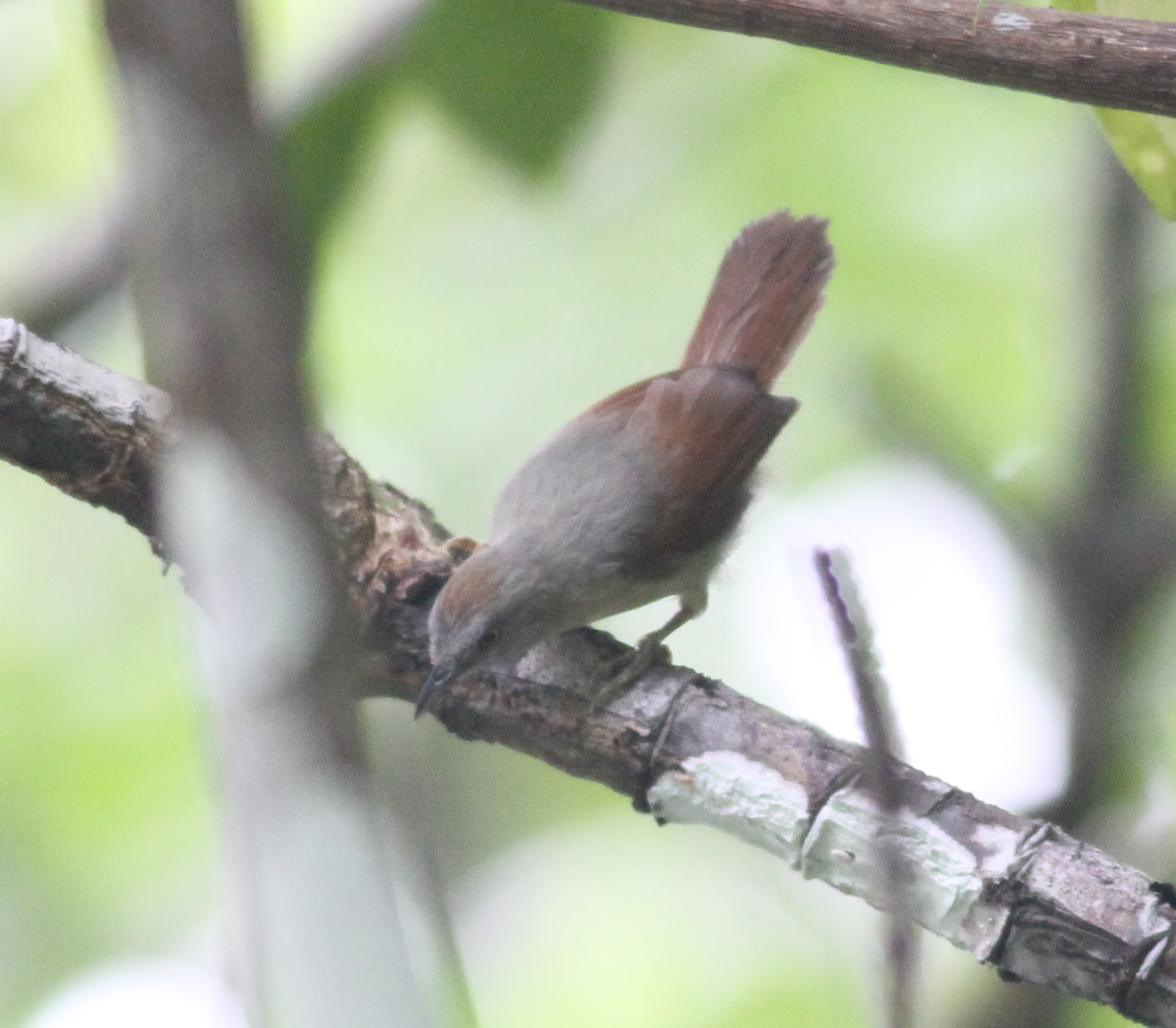
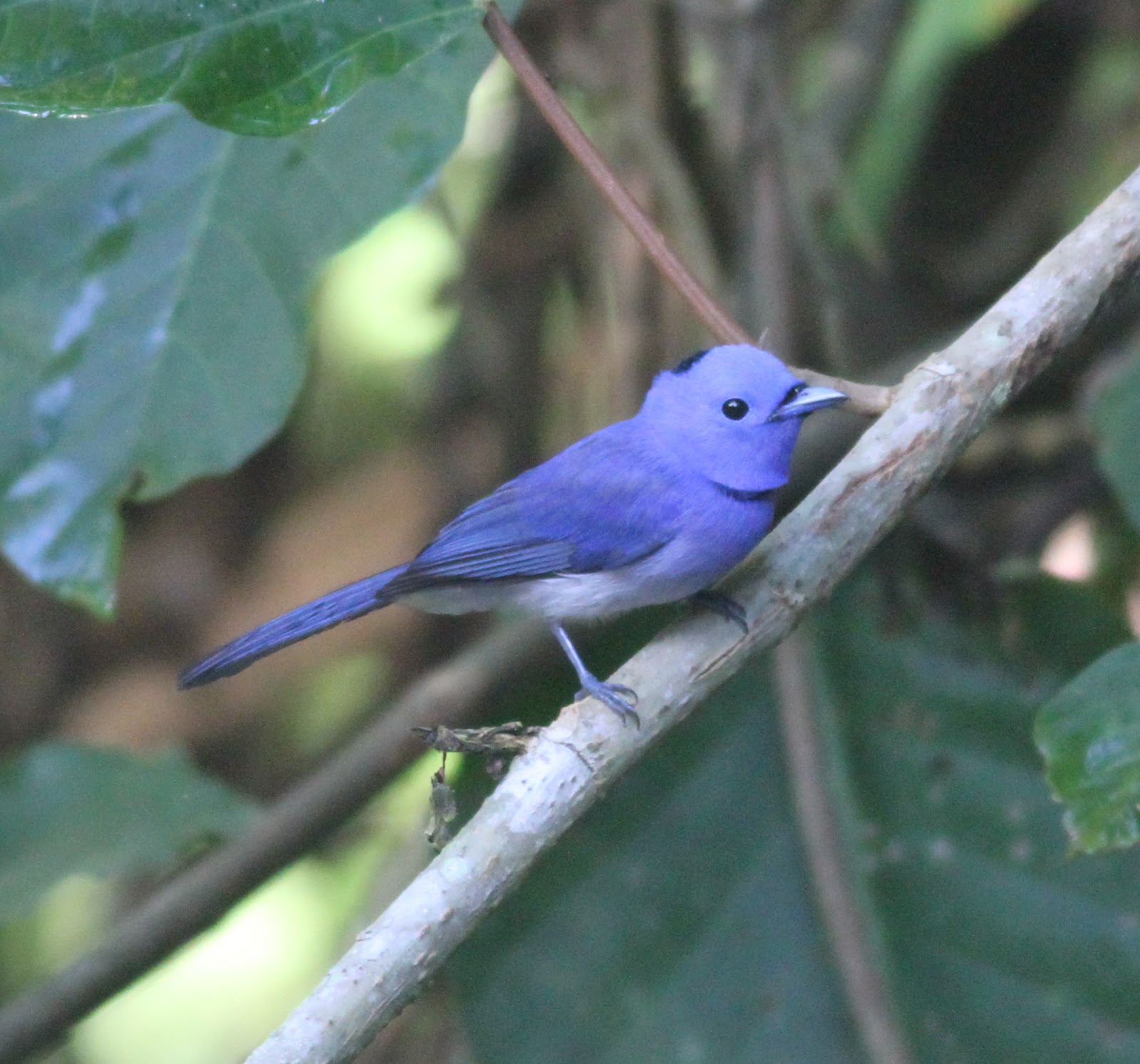
The fourth and final stop on my Palawan adventure. Zigzag Road is the name given to a stretch of diused road about 34km south of Puerto Princesa. The road itself is easy to find, just after the 34km marker going up to the right hand side of the main road. It was brilliant, and I should have budgeted more time here, I'm sure it would have produced more birds. My main target here was what was turning out to be a real bogey bird, Blue Paradise Flycatcher. I just hadn't been able to find it at Sabang or Iwahig. 2 minutes out of the van on Zigzag however, and there is the call! It responded immediately, and aggressively to playback, and I had a fantastic male in the bins! After that the birding continued very well. More calling Melodious Babbler, a very obliging Spot-throated Flameback, as well as Chestnut-breasted Malkoha (2), Dollarbird (2), calling Hooded Pitta (3+) with one visible, Yellow-throated Leafbird, Ashy-fronted Bulbul, Ashy Drongo, Hair-crested Drongo, Pin-striped Tit-Babbler and Rufous-tailed Tailorbird.
Spot-throated Flameback, Dinopium everetti. A recent split from Common Flameback, this is another 'new' Palawan endemic.
Chestnut-breasted Malkoha, ssp. harringtoni. Not easy to find, but very smart.
Blue Paradise Flycatcher. At last! This female was further up the road than my first bird. They proved to be quite common, with at least 4 calling birds in a 1 km stretch of road.
Yellow-throated Leafbird. Still one of my favourite Asian bird families.
Hair-crested Drongo, ssp. palawanensis. A very chunky bird, certainly when compared to ...
Ashy Drongo.Very slender for a drongo.
Rufous-tailed Tailorbird. Common, but tricky to see.
Pin-striped Tit-Babbler, Macronus gularis, ssp. woodi. Another recent split, from Bold-striped Tit-Babbler.
Spot-throated Flameback, Dinopium everetti. A recent split from Common Flameback, this is another 'new' Palawan endemic.
Chestnut-breasted Malkoha, ssp. harringtoni. Not easy to find, but very smart.
Blue Paradise Flycatcher. At last! This female was further up the road than my first bird. They proved to be quite common, with at least 4 calling birds in a 1 km stretch of road.
Yellow-throated Leafbird. Still one of my favourite Asian bird families.
Hair-crested Drongo, ssp. palawanensis. A very chunky bird, certainly when compared to ...
Ashy Drongo.Very slender for a drongo.
Rufous-tailed Tailorbird. Common, but tricky to see.
Pin-striped Tit-Babbler, Macronus gularis, ssp. woodi. Another recent split, from Bold-striped Tit-Babbler.
Iwahig - 9th June
For the third leg of my trip I stayed at a hotel in Puerto Princesa (Badjao Inn, 993 pesos/ night including AC). I hired a van and driver (from Estrelita Alejandria - 0920 295 3178) and on the morning of 9th I went to Iwahig. The guide was nice enough, but not particularly knowledgable, and spoke little English besides, so I was on my own, which is fine.
The first bird was a calling Hooded Pitta, which showed well, but only in silhouette so the photographs were poor. The trail is not long, but we took our time and had a pleasant morning. Most notable of the early birds was a couple of Melodious Babbler, which responded aggressively to playback, but were very shy to show themselves. When I finally did get eyes on them I was stunned to see how bulbul-like they were, I in fact dismissed one as a bulbul until my brain kicked in and I realised there were no brown bulbuls with white throats on Palawan (inlike Thailand where there are about 5!).
I also had good views of Spot-throated Flameback (1), Palawan Hornbill (2), Green Imperial Pigeon (3) and Crested Goshawk (1). At a spot towards the end of the trail its possible to sit by a stream, in a clearing. From here I had 3 different Hooded Pittas calling around me, as well as fly-over Blue-naped Parrots (4), a confiding male Black-naped Monarch and another Stork-billed Kingfisher.
Black-naped Monarch. This cracking male was quite unconcerned by my presence!
Green Imperial Pigeon, ssp. palawanensis. Fairly common throughout the forest on Palawan, but always wary.
Palwan Hornbill. One of the great Asian hornbills.
Small frog. By the stream.
The first bird was a calling Hooded Pitta, which showed well, but only in silhouette so the photographs were poor. The trail is not long, but we took our time and had a pleasant morning. Most notable of the early birds was a couple of Melodious Babbler, which responded aggressively to playback, but were very shy to show themselves. When I finally did get eyes on them I was stunned to see how bulbul-like they were, I in fact dismissed one as a bulbul until my brain kicked in and I realised there were no brown bulbuls with white throats on Palawan (inlike Thailand where there are about 5!).
I also had good views of Spot-throated Flameback (1), Palawan Hornbill (2), Green Imperial Pigeon (3) and Crested Goshawk (1). At a spot towards the end of the trail its possible to sit by a stream, in a clearing. From here I had 3 different Hooded Pittas calling around me, as well as fly-over Blue-naped Parrots (4), a confiding male Black-naped Monarch and another Stork-billed Kingfisher.
Black-naped Monarch. This cracking male was quite unconcerned by my presence!
Green Imperial Pigeon, ssp. palawanensis. Fairly common throughout the forest on Palawan, but always wary.
Palwan Hornbill. One of the great Asian hornbills.
Small frog. By the stream.
Pandan Island, Palawan - 7th to 8th June
Leg two of my Palawan trip. I took a jeepney from Sabang, changed to a tricycle at the main turn off and booked a boat at the pier for Honda Bay. The boat cost PHP 2800, and they agreed to let me stay overnight. At first they were adamant that it was a day resort only, but once I let them know that I was prepared to camp, and expected no facilities they relented.
Once the main visitors had left (@4pm) I deposited my gear with one of the stall keepers, and went birding. The island is pretty small, and can be circled in an hour or so. The fruit trees are the key to finding the pigeons, and I found quite a few Grey Imperial Pigeons (10+). They were easiest to see and photograph in the morning, but were findable in the afternoon too. At the north end of the island (opposite from the main resort) the scrub is quite dense, with no trails through. There were several Hooded Pitta here calling in the morning, and responding well to playback. A Tabon Scrubfowl was also here in the morning. Off shore this is the shallowest area, and had a few Grey-tailed Tattlers, Whimbrel, Greenshank (3) and Greater Sandplover (2). An offshore sandbar held Black-naped Tern (2), Great Crested Tern (3), Common Tern (10+), Little Tern (5+) and White-winged Black Tern (1). Lots of Little Heron here, often perched on the emerging mangrove seedlings.
The Eastern side of the island has lots of mangroves with several White-collared Kingfisher, and a pair of Stork-billed Kingfisher. A Great-billed Heron flew past here as the tide was dropping, eventually being tracked down to the shallows at the north end of the island.
The southern part, with the resort, has the tallest trees, and was where I eventually found Mantanani Scops Owl. They had not been active at all at sunset, possibly due to some rain and a little wind, and is wasn't until 2:00am that I was awakened by their calls. Half an hour later I finally got views of this strange island endemic. I also heard a few Large-tailed Nightjar here.
Grey Imperial Pigeon. The birds on Pandan do not have the "pinkish grey head, mantle and underparts" that are a feature of the nominate race, D. p. pickeringii, hence my assumption this is of the endemic race langhornei. The only Imperial Pigeon I found, this was fairly common. Easiest to
find in the late afternoon and early morning when they were quite vocal.
Stork-billed Kingfisher, ssp. gouldi. I found these at the mangroves in Sabang (mixed fresh/ salt water), at Pandan (salt), and on the forest stream at Iwahig (fresh). Clearly a very adaptable species, I wonder why it is not more widely distributed within the Philippines? Possibly it cannot compete with the smaller, but more aggressive White-collared Kingfisher, which this individual is defending itself against (unsuccessfully, it departed shortly after).
Little Heron. Using the mangrove saplings to hunt from on the receding tide.
Great-billed Heron. This was my first view of this hard to find Asian bird. I tracked it down to the reef at the north of the island, by then it was several hundred metres away...
... however the next morning I found it roosting on top of a tree at the north end of the island giving fabulous views. A second bird was on the west side.
Mantanani Scops Owl, possiby nominate ssp. mantanensis. This birds did not call at sunset, unlike their counterparts on Boracay (see my post). I eventually heard, then saw them, between 2 and 3 am
Hooded Pitta, ssp. palawanensis. The size of the black spot on the belly seems bigger than that of the bird I photographed on Pandan Island in Mindoro, but they are said to be "hardly seperable ... and may be considered synonymous". Possibly the difference in posture of the two birds accounts for the apparent size difference.
Female Brown-throated Sunbird, ssp. paraguae. The birds in Luzon and the north of the Philippines have been split from this, and are now considered to be an endemic species, Grey-throated Sunbird, Anthreptes griseigularis.
Once the main visitors had left (@4pm) I deposited my gear with one of the stall keepers, and went birding. The island is pretty small, and can be circled in an hour or so. The fruit trees are the key to finding the pigeons, and I found quite a few Grey Imperial Pigeons (10+). They were easiest to see and photograph in the morning, but were findable in the afternoon too. At the north end of the island (opposite from the main resort) the scrub is quite dense, with no trails through. There were several Hooded Pitta here calling in the morning, and responding well to playback. A Tabon Scrubfowl was also here in the morning. Off shore this is the shallowest area, and had a few Grey-tailed Tattlers, Whimbrel, Greenshank (3) and Greater Sandplover (2). An offshore sandbar held Black-naped Tern (2), Great Crested Tern (3), Common Tern (10+), Little Tern (5+) and White-winged Black Tern (1). Lots of Little Heron here, often perched on the emerging mangrove seedlings.
The Eastern side of the island has lots of mangroves with several White-collared Kingfisher, and a pair of Stork-billed Kingfisher. A Great-billed Heron flew past here as the tide was dropping, eventually being tracked down to the shallows at the north end of the island.
The southern part, with the resort, has the tallest trees, and was where I eventually found Mantanani Scops Owl. They had not been active at all at sunset, possibly due to some rain and a little wind, and is wasn't until 2:00am that I was awakened by their calls. Half an hour later I finally got views of this strange island endemic. I also heard a few Large-tailed Nightjar here.
Stork-billed Kingfisher, ssp. gouldi. I found these at the mangroves in Sabang (mixed fresh/ salt water), at Pandan (salt), and on the forest stream at Iwahig (fresh). Clearly a very adaptable species, I wonder why it is not more widely distributed within the Philippines? Possibly it cannot compete with the smaller, but more aggressive White-collared Kingfisher, which this individual is defending itself against (unsuccessfully, it departed shortly after).
Little Heron. Using the mangrove saplings to hunt from on the receding tide.
Great-billed Heron. This was my first view of this hard to find Asian bird. I tracked it down to the reef at the north of the island, by then it was several hundred metres away...
Mantanani Scops Owl, possiby nominate ssp. mantanensis. This birds did not call at sunset, unlike their counterparts on Boracay (see my post). I eventually heard, then saw them, between 2 and 3 am
Hooded Pitta, ssp. palawanensis. The size of the black spot on the belly seems bigger than that of the bird I photographed on Pandan Island in Mindoro, but they are said to be "hardly seperable ... and may be considered synonymous". Possibly the difference in posture of the two birds accounts for the apparent size difference.
Female Brown-throated Sunbird, ssp. paraguae. The birds in Luzon and the north of the Philippines have been split from this, and are now considered to be an endemic species, Grey-throated Sunbird, Anthreptes griseigularis.
Sabang, Palawan - 4th to 7th June
The first stop on my week-long trip to Palawan to try and mop up those endemics that I'm still missing. The first three days I spent at Sabang. The main target were the Philippine Cockatoos which have been found to roost in mangroves just off the main road into town. It took 2 days of visits, hiring a motorbike to take me there morning and evening, dodging rainshowers all the time, but eventually I scored, having a group of 6 birds come in at sunset on Tuesday afternoon. The site is pretty easy to find, 12km out of Sabang, just before the village of Tegabinet. Other birds here included Lovely Sunbird (recently split from Handsome Sunbird), Palawan Flowerpecker, Hill Myna, Dollarbird, Black-headed Bulbul, Ashy Drongo, Pin-striped Tit-Babbler, Green Imperial Pigeon. After dark several Large-tailed Nightjar were on the road back to town, plus another, smaller nightjar I couldn't identify.
The rest of the time was spent in the forest between the mangrove river and the first ranger camp. The main target here was the Falcated Ground Babbler, but there was hardly a sniff, with just one brown shape moving on the trail being a possibility. There were plenty of other birds here, including Crested Goshawk (1), Tabon Scrubfowl, Koel, Palawan Hornbill (2), Hooded Pitta (1), Yellow-throated Leafbird, Ashy-fronted Bulbul, Sulphur-bellied Bulbul, Palawan Bulbul, Spangled Drongo, White-vented Shama, Rufous-tailed Tailorbird, Lovely Sunbird, Pale Spiderhunter.
The mangrove river was still marvelous, producing a pair of fantastic Ruddy Kingfishers, as well as Spot-throated Flameback, Stork-billed Kingfisher, Pin-striped Tit-babbler, Common Iora, Blue-naped Parrot and on the beach by the mouth a pair of Malaysian Plovers, and several Eastern Reef-Egret, including a white phase individual.
Around Sabang itself garden birds included Asian Fairy Bluebird, Pale Spiderhunter, Ashy-fronted Bulbul, Sulphur-bellied Bulbul, Palawan Bulbul and Palawan Flowerpecker in the fruit trees at Dab-Dab, and Brown-backed Needletail overhead.

Ruddy Kingfisher, ssp. linae. One of a pair that showed on each of the three trips I took on the mangrove river. Very approachable individuals, this endemic race can be hard to find.
Eastern Reef-Egret. Several birds moving between the beach at the north end of Sabang beach and the mouth of the mangrove river.
A white phase and dark phase Eastern Reef Egret together. The white phase seems to be quite scarce.
Crested Goshawk, ssp. palawanus.
Malaysian Plover. A permanent fixture on the beach at the mouth of the mangrove river. This male in breeding plumage had a female in attendance.
Island Swiftlet, ssp. palawanensis. Mostly overhead near the Cockatoo viewpoint.
Lovely Sunbird Aethopyga shelleyi. A recent split from Handsome Sunbird, this is a 'new' Palawan endemic. The main distinguishing feature is the extent of the iridescence on the crown, the absence of a violet cheek spot, and the presence of red streaking on the yellow breast.
Philippine Cockatoo. The main target species. They roost at a regular spot 12km from Sabang. Mainly visible up to 6am, and after 4pm as they travel to the roost, which is over 1km from the viewpoint, and presents rather poor views.
Pale Spiderhunter Arachnothera dilutior. Another recent split, from Little Spiderhunter, creating another Palawan endemic. The main feature is the absence of bright yellow flanks and lower belly.
Asian Fairy Bluebird. This had become something of a bogey bird, until I finally turned one up in the garden of a restaurant in Sabang.
Water Monitor. Common, particularly in the mangroves.
Mangrove Snake. Common in the mangroves, I have yet to take a boat trip up the mangrove river without seeing one (7 trips)
Displaying male Philippine Flying Lizard. This was the culminating point in a 10 minute battle between two (presumably) male Flying Lizards that chased each other between several trees. They finally faced off, about 2 feet apart, with wings and throat-flap fully extended, in a what appears to be a threat display.
Red-tailed Squirrel. Common in all forest types, the best views I had were in the palm trees around Sabang.
The rest of the time was spent in the forest between the mangrove river and the first ranger camp. The main target here was the Falcated Ground Babbler, but there was hardly a sniff, with just one brown shape moving on the trail being a possibility. There were plenty of other birds here, including Crested Goshawk (1), Tabon Scrubfowl, Koel, Palawan Hornbill (2), Hooded Pitta (1), Yellow-throated Leafbird, Ashy-fronted Bulbul, Sulphur-bellied Bulbul, Palawan Bulbul, Spangled Drongo, White-vented Shama, Rufous-tailed Tailorbird, Lovely Sunbird, Pale Spiderhunter.
The mangrove river was still marvelous, producing a pair of fantastic Ruddy Kingfishers, as well as Spot-throated Flameback, Stork-billed Kingfisher, Pin-striped Tit-babbler, Common Iora, Blue-naped Parrot and on the beach by the mouth a pair of Malaysian Plovers, and several Eastern Reef-Egret, including a white phase individual.
Around Sabang itself garden birds included Asian Fairy Bluebird, Pale Spiderhunter, Ashy-fronted Bulbul, Sulphur-bellied Bulbul, Palawan Bulbul and Palawan Flowerpecker in the fruit trees at Dab-Dab, and Brown-backed Needletail overhead.
Ruddy Kingfisher, ssp. linae. One of a pair that showed on each of the three trips I took on the mangrove river. Very approachable individuals, this endemic race can be hard to find.
Crested Goshawk, ssp. palawanus.
Malaysian Plover. A permanent fixture on the beach at the mouth of the mangrove river. This male in breeding plumage had a female in attendance.
Lovely Sunbird Aethopyga shelleyi. A recent split from Handsome Sunbird, this is a 'new' Palawan endemic. The main distinguishing feature is the extent of the iridescence on the crown, the absence of a violet cheek spot, and the presence of red streaking on the yellow breast.
Philippine Cockatoo. The main target species. They roost at a regular spot 12km from Sabang. Mainly visible up to 6am, and after 4pm as they travel to the roost, which is over 1km from the viewpoint, and presents rather poor views.
Pale Spiderhunter Arachnothera dilutior. Another recent split, from Little Spiderhunter, creating another Palawan endemic. The main feature is the absence of bright yellow flanks and lower belly.
Asian Fairy Bluebird. This had become something of a bogey bird, until I finally turned one up in the garden of a restaurant in Sabang.
Water Monitor. Common, particularly in the mangroves.
Mangrove Snake. Common in the mangroves, I have yet to take a boat trip up the mangrove river without seeing one (7 trips)
Displaying male Philippine Flying Lizard. This was the culminating point in a 10 minute battle between two (presumably) male Flying Lizards that chased each other between several trees. They finally faced off, about 2 feet apart, with wings and throat-flap fully extended, in a what appears to be a threat display.
Red-tailed Squirrel. Common in all forest types, the best views I had were in the palm trees around Sabang.
Saturday, June 2, 2012
Butterflies and Lizards - ISH - 3 June
Family duties kept me out of the forest for the first couple of days of the long holidays, but I managed to persuade my 4 year-old to come for a walk along a small stream adjacent to the housing compound at IRRI. Birdwise it was fairly thin apart from a surprise glimpse of Indigo-banded Kingfisher on the stream, my first for months. White-throated Kingfisher, Glossy Swiftlet, Island Swiftlet, Asian Palm Swift and Striated Swallow were the only other birds.
It was a great day for butterflies though, and I managed to take photos of a couple of lizards too, so all in all pretty productive.
Green Dragontail, Lamproptera meges
Cruiser, Vindula erota
Great Eggfly, Hypolimnas bolina. Thanks to Lydia Robledo for the ID.
Common Bluebottle, Graphium sarpedon...
.. very fast, this is a hard butterfly to photograph in flight!
I believe this is a Tree Yellow, Gandaca harina.
Common Sailor, Neptis hylas.
Unidentified
Skink sp.
Flying Lizard, Draco sp.
It was a great day for butterflies though, and I managed to take photos of a couple of lizards too, so all in all pretty productive.
Green Dragontail, Lamproptera meges
Cruiser, Vindula erota
Great Eggfly, Hypolimnas bolina. Thanks to Lydia Robledo for the ID.
Common Bluebottle, Graphium sarpedon...
.. very fast, this is a hard butterfly to photograph in flight!
I believe this is a Tree Yellow, Gandaca harina.
Common Sailor, Neptis hylas.
Unidentified
Skink sp.
Flying Lizard, Draco sp.
Subscribe to:
Posts (Atom)